Solar Loan vs. Lease vs. PPA: What Happens When You Sell Your Home?
Compare owned solar, solar loans, leases, and PPAs during a home sale, including payoff, transfer, buyer approval, and title questions.
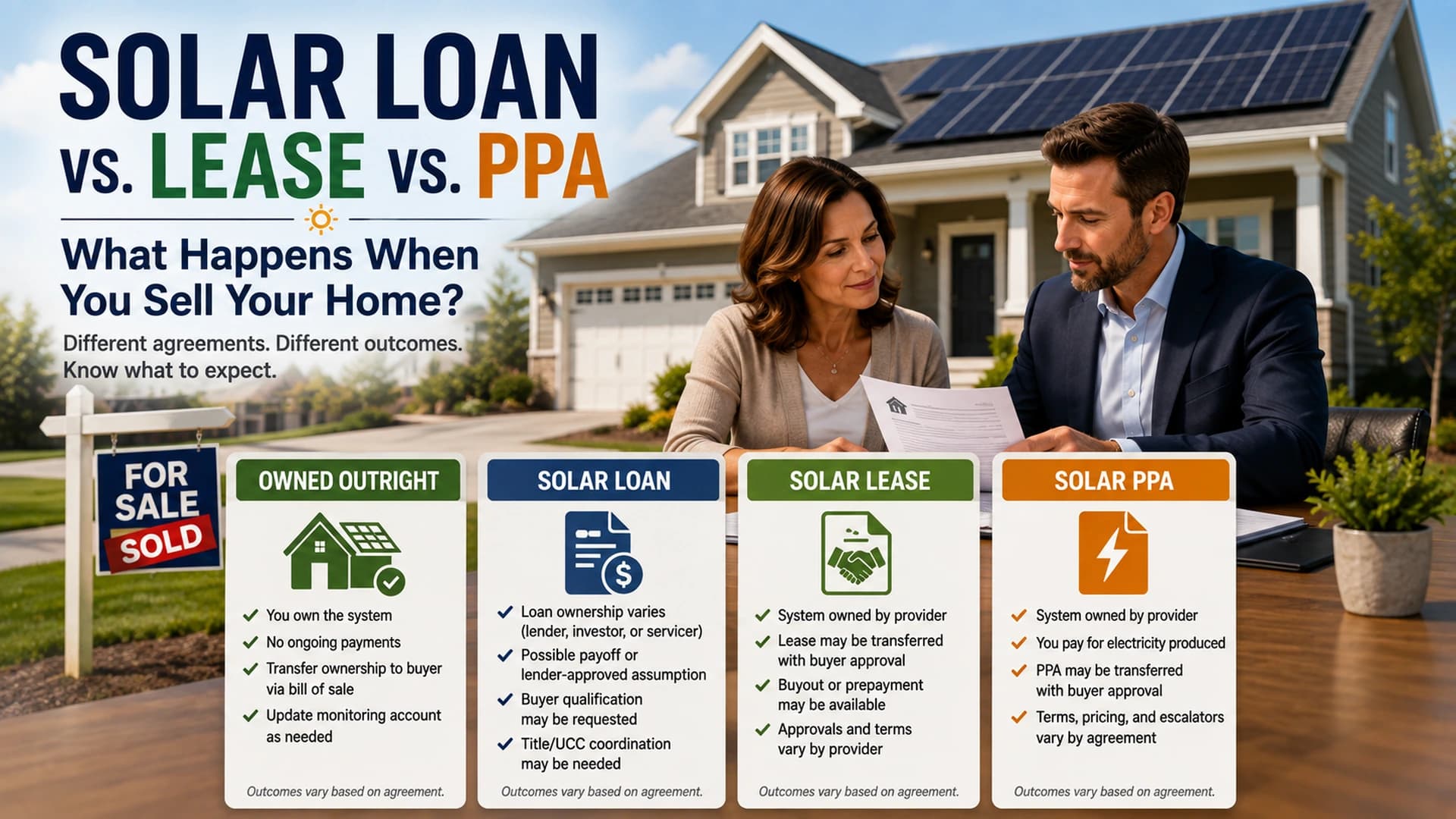
A homeowner tells the Realtor, "The house has solar."
That is useful, but it is not enough information to plan the sale.
The system could be owned outright. It could be financed with a solar loan. It could be leased. It could be under a power purchase agreement, or PPA. Each arrangement can create different questions about ownership, payoff, buyer approval, transfer paperwork, title records, and who needs to be contacted before closing.
This guide explains the difference between owned solar, solar loans, solar leases, and solar PPAs in the context of a home sale. It is not a generic guide to choosing solar financing before installation. The transaction question is narrower: what happens to the existing solar arrangement when the home is sold?
If you need the broader seller workflow, start with Oversiq's guide to selling a house with solar panels. This article focuses on the agreement type.
Quick Answer: What Happens to Solar When You Sell a House?
Do not assume the solar automatically transfers with the home. What happens depends on the agreement.
Owned outright
If the homeowner owns the solar panels outright and there is no remaining solar financing obligation, the parties may generally treat the system as part of the property sale. That does not mean there is nothing to do. The seller may still need to provide system documents, warranty information, monitoring access, utility records, and any proof that old financing or title filings were resolved.
Solar loan
With a solar loan, the homeowner usually owns the system but still owes money to a lender, creditor, or current servicer. The sale may require the seller to pay off the loan, or the buyer may be able to assume the loan if the lender permits it and approves the buyer. The details depend on the loan documents and current servicer requirements.
Solar lease
With a solar lease, a third-party owner usually owns the system and the homeowner pays for use of the equipment or service. A sale may require a provider-approved transfer, buyer qualification, contract assignment, or another sale-specific step. Some agreements may also include prepayment or buyout options.
Solar PPA
With a solar PPA, a third-party owner usually owns the system and the homeowner pays for the electricity the system generates. A sale may require transfer or assignment of the PPA, buyer approval, provider consent, and review of the remaining term, rate, escalator, and title documents.
Key Takeaways
- Solar is not one standardized contract.
- System ownership and payment responsibility are separate questions.
- The installer, solar provider, lender, creditor, servicer, lease provider, and PPA provider may not be the same company.
- Payoff, assumption, assignment, and account transfer are different events.
- Buyer approval may depend on the agreement and provider.
- Collecting the right documents early can reduce closing surprises.
Solar Loan vs. Lease vs. PPA: Home-Sale Comparison
| Question | Owned Outright | Solar Loan | Solar Lease | Solar PPA |
|---|---|---|---|---|
| Who typically owns the system? | The homeowner. | The homeowner, often subject to lender or secured-party rights. | A third-party owner or provider. | A third-party owner or provider. |
| What is the homeowner paying for? | No solar financing payment if fully paid off. | Repayment of money borrowed to buy the system. | Use of the solar equipment or service. | Electricity generated by the system, often at a contract rate. |
| Is there an ongoing obligation? | Usually no solar financing obligation, but service or warranty terms may remain. | Yes, if the loan is not paid off. | Usually yes, under the lease. | Usually yes, under the PPA. |
| What may happen when the home is sold? | System ownership may convey, while documents and accounts may need handoff. | Seller may pay off the loan or seek approved buyer assumption if available. | Provider may require transfer, assignment, buyer approval, buyout, or prepayment. | Provider may require PPA transfer, assignment, buyer approval, buyout, or prepayment. |
| Could buyer qualification be involved? | Usually not for the solar system itself. | May be required for loan assumption. | May be required by the provider. | May be required by the provider. |
| Could payoff or buyout be involved? | Usually only if old financing or obligations remain. | Payoff may be required or chosen. | Buyout or prepayment may be available if the agreement allows it. | Buyout or prepayment may be available if the agreement allows it. |
| Could assumption, assignment, or transfer be involved? | Account, warranty, utility, or monitoring transfer may still matter. | Loan assumption may be possible if lender-approved. | Lease transfer or assignment may be required. | PPA transfer or assignment may be required. |
| Who should the seller contact? | Installer, manufacturer, utility, or monitoring provider as needed. | Current lender, creditor, or servicer. | Current lease provider or transfer team. | Current PPA provider or transfer team. |
| Could title/UCC questions arise? | Possible if there were prior filings or unresolved records. | Possible if the loan has a UCC or security interest. | Possible if the third-party owner recorded a UCC, notice, or similar filing. | Possible if the third-party owner recorded a UCC, notice, or similar filing. |
| What document should the seller find first? | Proof of ownership, paid-off status, warranties, and system records. | Loan agreement and current statement. | Solar lease agreement and current statement. | PPA agreement and current statement. |
The table is a starting point, not a substitute for the actual agreement. The contract, current provider or servicer, title findings, and lender requirements control the real transaction steps.
Oversiq Insight: Not sure what solar agreement you have? Start by gathering the original agreement, the most recent statement, and any transfer, payoff, or title documents. Those documents usually reveal whether you are dealing with owned solar, a loan, a lease, or a PPA.
First: Figure Out What Type of Solar Agreement You Have
Before anyone can plan the sale, the transaction team needs to identify the agreement type.
Start with the document title and payment terms. A cash purchase agreement, paid invoice, or paid-off loan statement may suggest owned solar. A promissory note, retail installment contract, loan agreement, or financing agreement points toward a solar loan. A lease agreement usually says the homeowner is paying for use of the solar equipment or related service. A power purchase agreement usually says the homeowner is buying electricity generated by the system at a contract rate. The Department of Energy's Homeowner's Guide to Solar makes the same basic distinction among purchased systems, solar loans, leases, and PPAs.
Look for these clues:
- Who owns the system?
- Who receives the monthly payment?
- Is the payment a loan payment, lease payment, or energy-production charge?
- Is there a remaining term?
- Does the document mention assumption, assignment, transfer, buyout, prepayment, or sale of the home?
- Is there a UCC-1, fixture filing, notice, or title document?
- Does the current statement show a different servicer than the original paperwork?
This is where many solar home sales get confusing. The company that installed the panels may not be the current lender, creditor, servicer, lease provider, PPA provider, or secured party. The right contact is often the company currently handling billing, payoff, transfer, or title documents.
If a term is unfamiliar, use the Oversiq Solar Glossary to separate consumer phrases from contract language.
What Happens If You Own the Solar Panels Outright?
Owned outright usually means the homeowner owns the system and has no remaining solar-specific financing obligation. This may be the simplest home-sale category, but it still requires verification.
The seller should be prepared to show:
- system ownership or paid-off status,
- installation records,
- permission-to-operate or utility interconnection documents,
- equipment and inverter information,
- warranty documents,
- monitoring or app account information,
- service history,
- utility or net-metering details where relevant.
If the system was once financed, leased, or under a PPA, title or closing professionals may also want to confirm that old UCC filings, notices, or provider records were resolved. "Paid off" does not always mean the paperwork caught up automatically.
Buyers should also ask how monitoring access, warranty information, and utility records will be transferred after closing. The system may be physically attached to the home, but the practical handoff can still involve accounts, apps, records, and provider communications.
What Happens to a Solar Loan When You Sell Your House?
With a solar loan, the homeowner usually purchased the system and borrowed money to pay for it. The homeowner may own the panels, but the loan obligation can still affect the sale. The CFPB's solar financing issue spotlight explains that if a homeowner sells before a solar loan is paid off, common options can include lender-permitted buyer assumption or seller payoff before sale.
The two common paths are:
- The seller pays off the solar loan before or at closing.
- The buyer assumes the solar loan, if the lender permits assumption and approves the buyer.
Neither path should be assumed without written instructions from the current lender or servicer.
The current servicer matters. A loan may have been originated by one company, funded by a bank partner, assigned to another creditor, and serviced by another company. The seller should request a current payoff quote or assumption instructions from the party actually handling the account today.
Solar loan questions to verify early:
- What is the current unpaid balance?
- Is there a payoff quote valid through the closing date?
- Is buyer assumption available for this loan?
- If assumption is available, what must the buyer submit?
- Does the buyer need credit approval?
- Is there a UCC-1, fixture filing, or other title record?
- Who will confirm release, payoff, or post-closing responsibility?
Provider examples show why contract-specific review matters. GoodLeap describes payoff or buyer assumption subject to underwriting and approval. Dividend Finance materials describe payoff or transfer processes tied to buyer credit requirements. Tesla distinguishes Tesla Loan, third-party loan, lease, PPA, MyPower, and cash-purchase workflows.
For a deeper loan-specific explanation, read Can a Buyer Assume a Solar Loan?.
What Happens to a Solar Lease When You Sell Your House?
With a solar lease, the homeowner usually does not own the system. A third-party owner or provider owns the equipment, and the homeowner pays for the use of the system or service under a long-term agreement. The FTC's solar power consumer guidance explains that lease and PPA customers generally do not own the system and generally do not receive ownership-based tax credits or incentives.
During a sale, the lease agreement may require a transfer or assignment process. The provider may need information about the seller, buyer, Realtor, escrow company, title company, closing date, and property. The buyer may need to sign transfer documents or qualify under provider requirements.
The exact process varies. Some providers describe buyer credit review. Some agreements may allow buyout, prepayment, or other sale options. Some may require the seller to resolve the agreement if the buyer will not take it over. Do not assume every lease transfers automatically.
For the seller workflow in more detail, read Oversiq's solar lease transfer guide for selling a home.
Buyers comparing these structures before closing can also use Oversiq's buyer guide to homes with solar panels.
Seller questions to ask:
- What is the remaining lease term?
- What is the current monthly payment?
- Are there annual escalators?
- Is the lease transferable?
- Does the buyer need approval?
- Is buyout or prepayment available?
- Are there transfer fees or document-processing fees?
- Are title/UCC documents recorded?
- When should the transfer process begin?
Sunrun and Sunnova materials, for example, describe transfer workflows involving buyer information, transfer documents, and credit review in some contexts. Tesla lease materials describe transfer and buyout options depending on the agreement. These examples show variation; they are not universal lease rules.
What Happens to a Solar PPA When You Sell Your House?
A power purchase agreement, or PPA, is different from a loan and different from a lease.
With a PPA, a third-party owner usually owns and maintains the system, and the homeowner buys the electricity the system produces. The payment is often tied to kilowatt-hours generated, contract rates, and sometimes escalators. DOE guidance distinguishes a solar lease from a PPA by explaining that a lease is generally tied to use of the system, while a PPA is generally tied to power generated by the system.
During a home sale, the PPA may need to be transferred or assigned to the buyer. The provider may require buyer approval, signed transfer documents, escrow or title information, and confirmation after closing. The buyer should review the remaining term, rate schedule, escalator, production terms, buyout options, maintenance obligations, and final billing process.
Questions to ask:
- Who owns the system?
- What rate does the homeowner pay for generated electricity?
- Does the rate increase over time?
- How many years remain?
- Can the PPA be transferred?
- Does the buyer need provider approval?
- Are there buyout or prepayment options?
- Are there UCC or title notices?
- Who handles the final seller invoice and new buyer account?
Tesla, Sunrun, and Sunnova materials all show that PPA or service-transfer procedures can require provider-specific steps. The contract and current provider instructions matter more than a general rule.
Solar Lease vs. PPA: Why the Difference Matters During a Sale
A solar lease and a solar PPA can look similar during a home sale because both often involve third-party ownership and provider transfer steps. The payment structure is the key difference.
Under a lease, the customer generally pays for use of the system or solar service. Under a PPA, the customer generally pays for electricity generated by the system, often at a contract rate per kilowatt-hour.
That difference can affect buyer review. A buyer looking at a lease may focus on fixed payment, term, escalator, maintenance, and end-of-term options. A buyer looking at a PPA may focus on energy rate, production, escalator, utility comparison, buyout options, and billing mechanics.
For both leases and PPAs, the sale process still depends on the actual agreement and provider instructions.
Payoff vs. Assumption vs. Transfer: These Are Not the Same Thing
"The solar transfers" is not precise enough for a real estate transaction.
Different events may be involved:
- Payoff: the seller pays the remaining balance or required amount under lender or provider instructions.
- Loan assumption: the buyer becomes responsible for a solar loan, if the lender permits it and approves the buyer.
- Contract assignment: rights and obligations under an agreement are assigned according to the contract.
- Lease transfer: the buyer takes over a solar lease or service agreement if the provider allows it.
- PPA transfer: the buyer takes over the power purchase agreement if the provider allows it.
- System ownership transfer: ownership records for the system are updated.
- Account or monitoring transfer: app access, monitoring, utility records, warranty information, or customer-service records are moved to the new owner.
These events can happen together, but they are not the same. A buyer might take over monitoring access without assuming a loan. A seller might pay off a loan while the buyer receives the system free of that debt. A lease or PPA might require provider transfer even though no loan is being assumed.
The safest transaction plan identifies exactly what must happen before or at closing.
Does the Buyer Have to Qualify?
Sometimes. Not always.
Buyer qualification may come up when:
- a buyer wants to assume a solar loan,
- a buyer is taking over a solar lease,
- a buyer is taking over a PPA or service agreement.
For loan assumption, the lender may require the buyer to apply and satisfy underwriting requirements. For lease or PPA transfer, the provider may require signed documents, account setup, credit review, or another approval process.
Provider examples vary. Sunrun describes a soft credit check in service-transfer contexts. Sunnova describes buyer credit requirements and, in some cases, a deposit alternative. GoodLeap and Dividend materials describe buyer approval requirements for certain loan transfer or assumption paths.
But do not assume every buyer must qualify. Paid-off systems, prepaid agreements, owned systems, and some contract structures may be different. The agreement and provider instructions control.
Who Do You Contact About the Solar Agreement?
One of the biggest mistakes in a solar home sale is contacting only the original installer.
The relevant party may be:
- Installer: the company that installed the system.
- Solar provider: the company that manages the customer relationship or system.
- Lender: the company or financial institution that originated or funded the loan.
- Creditor or loan owner: the party that owns the receivable today.
- Servicer: the company that handles payments, statements, payoff, and customer support.
- Lease provider: the company that owns or manages the leased system.
- PPA provider: the company that owns or manages the system and sells the generated electricity.
- Secured party: the party listed in a UCC filing as having a security interest in collateral.
These roles may overlap, but they do not always. A borrower may have old paperwork from one brand, a current statement from another servicer, and a UCC filing naming a different secured party.
That is why the current statement, payoff instructions, transfer packet, and title documents matter. They help identify who is actually responsible today.
If company status is unclear, check Oversiq's Solar Company Status Center and confirm directly with the current account statement or provider portal.
Could a Solar UCC Filing Affect the Transaction?
Yes, a solar UCC filing or related title document can become relevant during a sale. That does not automatically mean there is a mortgage-style lien on the house.
Solar UCC filings may be used to give public notice of a security interest in solar equipment or a third-party owner's interest in a system installed at the property. The exact effect depends on the filing, collateral description, agreement type, lender requirements, and title review.
Fannie Mae and Freddie Mac both address solar ownership, financing structure, leases, PPAs, UCC records, and related documentation in mortgage guidance. That is why a filing may not be a mortgage-style real-property lien and still need attention in a closing file.
The transaction team should ask:
- Is there a UCC-1, fixture filing, notice, or memorandum?
- Who is the secured party or filing party?
- Does the filing describe the solar equipment, the real property, or both?
- Does the mortgage lender require release, subordination, or explanation?
- Has the provider or lender issued any temporary release or UCC-3 document?
For a deeper explanation, read Solar UCC Filing Explained.
What If the Original Solar Company Went Bankrupt or Closed?
If the original installer or solar company went bankrupt, closed, sold assets, or changed servicers, that does not automatically cancel a loan, lease, or PPA.
The important question is who handles the obligation now.
A loan may be serviced by a different company than the original installer. A lease or PPA may be assigned, serviced, or administered by another provider. A secured party in a filing may not be the brand the homeowner remembers from the sales process.
This can affect:
- payoff requests,
- assumption or transfer instructions,
- customer support,
- warranty questions,
- UCC/title documents,
- post-closing account changes.
Use old paperwork as a starting point, not the final answer. Verify the current provider, servicer, creditor, or secured party before planning the sale.
For more on company failure, read What Happens If Your Solar Company Goes Bankrupt?. For current company-status context, use the Solar Company Status Center.
What Sellers Should Gather Before Listing
The earlier a seller gathers solar documents, the easier it is to answer buyer, Realtor, title, lender, and attorney questions.
Essential
- Original solar agreement.
- Current billing statement.
- Current provider, lender, or servicer contact information.
- Loan agreement, lease, or PPA if separate from the installation contract.
- Payoff, transfer, or assumption instructions if already requested.
Useful
- Installation contract.
- System specifications.
- Permission-to-operate documentation.
- Utility interconnection or net-metering records.
- Warranty documents.
- Monitoring or app account information.
- Service or maintenance history.
Situational
- UCC-1, fixture filing, title notice, or recorded memorandum.
- UCC-3, release, temporary release, or subordination paperwork.
- Buyout or prepayment quote.
- Company or servicer change notices.
- Transfer agreement drafts.
- Written confirmation after payoff, transfer, or assumption.
Tip: If the seller cannot find the contract, start with the most recent statement, the provider portal, and title search results. Those often reveal the current contact and agreement type.
What Realtors Should Verify Before Listing a Home With Solar
Realtors do not need to become solar finance experts. They do need to identify the issue early enough that the right people can review it.
A practical intake workflow:
- Ask whether the home has solar before the listing goes live.
- Ask whether the system is owned, financed, leased, or under a PPA.
- Request the actual solar agreement and current statement.
- Identify the current provider, lender, servicer, or transfer team.
- Ask whether payoff, assumption, transfer, buyout, or assignment may be involved.
- Ask whether buyer approval may be required.
- Ask title early whether any solar filing appears.
- Avoid promising that the buyer can assume, transfer, or reject the obligation.
- Flag unclear terms for lender, title, provider, attorney, or other appropriate professional review.
- Track solar deadlines alongside inspection, mortgage, title, and closing deadlines.
This is especially important when the listing description simply says "solar panels included" or "solar lease transfers." Those phrases may not match the actual contract.
Use the Realtor Solar Listing Checklist for a practical intake tool, and see Oversiq Realtor Resources for additional professional guidance.
What Buyers Should Review Before Taking Over a Solar Arrangement
Buying a home with solar can mean different things. Buying the house is one decision; agreeing to take over a solar obligation is a separate transaction question.
The buyer may receive a paid-off system. The buyer may take the home only if the seller pays off the solar loan. The buyer may seek approval to assume a loan. Or the buyer may be asked to sign a lease, PPA, or service transfer.
Before agreeing, buyers should review:
- who owns the equipment,
- what obligation remains,
- monthly payment or energy rate,
- remaining term,
- escalator or rate-increase language,
- transfer or qualification process,
- current provider or servicer,
- maintenance and warranty obligations,
- roof and system service history,
- title/UCC documents where applicable,
- seller promises in the purchase contract or solar addendum.
The buyer should also confirm whether their mortgage lender needs to consider solar payments, title filings, or lease/PPA terms. Fannie Mae and Freddie Mac mortgage guidance both treat solar ownership and financing structure as relevant to underwriting and documentation review.
When Title or an Attorney Should Be Involved
Some solar questions are document and workflow questions. Others deserve professional review.
Escalate when:
- system ownership is unclear,
- a UCC/security-interest issue appears,
- payoff or release requirements are disputed,
- assignment or transfer language conflicts with the purchase contract,
- the current creditor, servicer, or provider is unclear,
- a bankruptcy or successor issue affects the current responsible party,
- title, lender, solar provider, buyer, and seller instructions do not match,
- the buyer refuses to take over a lease/PPA and the contract does not explain what happens next.
This article is educational and not legal, tax, mortgage, or title advice. Specific filings and agreements should be reviewed by the appropriate professionals.
For title-focused solar transaction resources, see Oversiq Title Company Resources.
Common Solar Home-Sale Misconceptions
Myth: The buyer automatically takes over the solar.
Reality: The buyer may receive the system, assume a loan, sign a lease/PPA transfer, or require the seller to resolve the obligation. The agreement controls.
Myth: All solar loans are assumable.
Reality: Some lenders may permit assumption, but approval is not automatic. The buyer may need to apply and qualify.
Myth: Solar leases and PPAs are the same.
Reality: Both often involve third-party ownership, but a lease generally relates to use of the system, while a PPA generally relates to purchasing electricity the system generates.
Myth: The installer owns the loan.
Reality: The installer may have sold the system, but the loan may be owned, funded, assigned, or serviced by another company.
Myth: If the installer went bankrupt, I do not owe anything.
Reality: Financing, lease, PPA, or servicing obligations may continue through another creditor, provider, servicer, or assignee.
Myth: Paid-off panels mean there is nothing else to transfer.
Reality: Documents, warranties, monitoring access, utility records, and old title filings may still need attention.
Myth: Every UCC filing is a property lien.
Reality: Some solar UCC filings relate to equipment or third-party ownership interests, not a mortgage-style real-property lien. Title and lender requirements still matter.
Frequently Asked Questions
What happens to a solar loan when you sell your house?
The seller may need to pay off the loan, or the buyer may be able to assume it if the lender allows assumption and approves the buyer. The seller should request current payoff or assumption instructions from the current lender or servicer.
Do solar panels have to be paid off before selling?
Not always. Paid-off or owned systems are different from financed, leased, or PPA systems. Some solar loans may be paid off at closing, some may allow assumption, and leases or PPAs may use transfer, buyout, or assignment procedures instead of loan payoff.
Can a buyer assume a solar loan?
Sometimes. Buyer assumption depends on the lender, loan documents, buyer qualification, and approval process. See Oversiq's guide to buyer solar loan assumption for deeper detail.
What happens to a solar lease when you sell?
The lease provider may require a transfer or assignment process before or after closing. The buyer may need to sign documents or qualify under provider requirements, and some agreements may include buyout or prepayment options.
Can you transfer a solar lease to a buyer?
Often the sale process is designed around transfer, but it is not automatic. The lease terms and provider instructions determine what the seller and buyer must do.
What happens to a PPA when you sell a house?
The PPA may need to be transferred or assigned to the buyer if the provider permits it. The buyer should review the remaining term, energy rate, escalator, production terms, and transfer requirements before agreeing.
What is the difference between a solar lease and a PPA?
With a lease, the customer generally pays for use of the solar equipment or service. With a PPA, the customer generally pays for the electricity the system produces. Both may involve third-party ownership and provider transfer steps during a home sale.
What happens to paid-off solar panels when you sell?
Paid-off panels may usually be handled more simply, but the seller should still provide ownership proof, warranties, monitoring information, utility records, and any documentation showing old financing or filings were resolved.
The Bottom Line
Before planning a home sale with solar, answer five questions:
- Who owns the system?
- What agreement exists?
- What obligation remains?
- Who handles that obligation today?
- What must happen before or at closing?
Those questions matter more than the phrase "the house has solar." A paid-off system, a solar loan, a lease, and a PPA can all point to different documents, contacts, approvals, and closing tasks.
If you are preparing to sell, gather the agreement, current statement, provider or servicer contact, and any transfer, payoff, or title documents as early as possible. If the documents are unclear, use Oversiq to organize the solar agreement and identify the issues to raise with your Realtor, buyer, title company, lender, or attorney.
About the author
Oversiq Editorial Team creates educational resources about residential solar documents, financing terms, company risk, and real estate transaction issues for Oversiq readers.