Buying a House With Solar Panels: What Buyers Need to Know Before Closing
A buyer-focused guide to reviewing solar panels before closing, including ownership, solar loans, leases, PPAs, UCC filings, mortgage review, and documents to request.
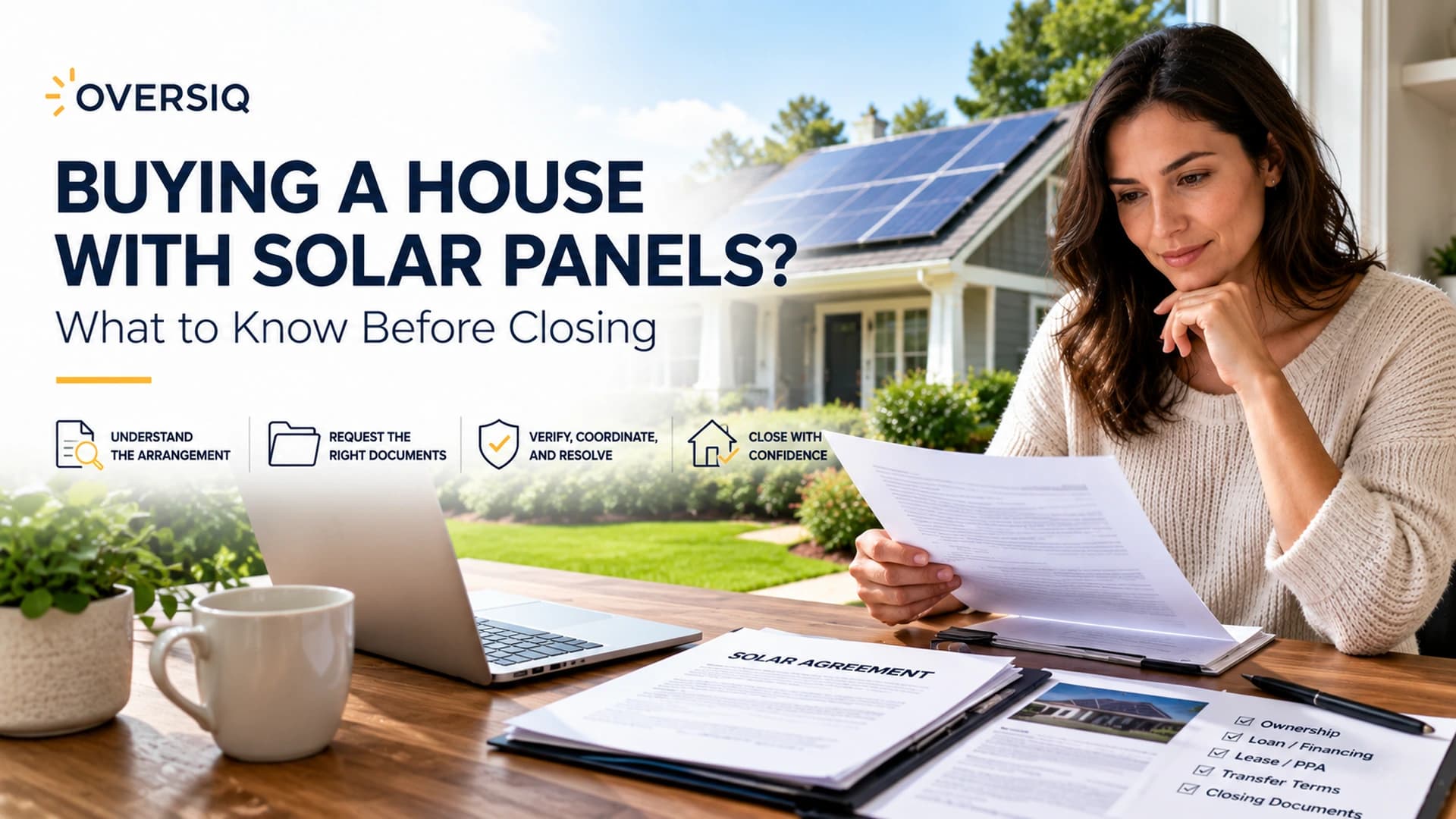
Buying a house with solar panels is not automatically a problem. Solar may lower utility costs, support energy goals, or add a feature the buyer values. The real question is what financial, contractual, ownership, transfer, title, mortgage, and servicing arrangements come with those panels.
A home with solar can be simple if the seller owns the system free and clear and the documents are clean. It can also require more review if there is a solar loan, lease, power purchase agreement, UCC filing, provider transfer process, or servicer change. Verify the arrangement early, request the documents, and make sure the right transaction participants understand what still needs to happen before closing.
This guide is written for buyers first. If you are selling the home instead, start with Oversiq's seller-side guide to selling a house with solar panels.
Before Buying a House With Solar Panels, Verify These 6 Things
Before buying a house with solar panels, try to answer these six questions as early as possible:
- Who owns the solar equipment? The seller, a solar provider, or another system owner may have different rights and responsibilities. A lender or creditor may also have a security interest or payoff role.
- Is there money still owed? A seller may have an outstanding solar loan, a lease payment, a PPA payment, or another account obligation.
- Is the system owned, financed, leased, or under a PPA? Each structure can affect what transfers, what gets paid, and what documents your lender or title team may request.
- What does the agreement say happens when the property is sold? The sale section, transfer section, assumption clause, payoff instructions, and assignment language matter more than a verbal summary.
- Are there UCC, title, mortgage, or appraisal questions? Some solar arrangements involve public records or underwriting review. That does not automatically mean the home cannot close, but it should be investigated.
- What written confirmation is needed before closing? Depending on the arrangement, you may need payoff confirmation, transfer approval, assumption documents, release/subordination documents, warranty transfer information, or current servicer instructions.
The point is not to treat solar as a defect. It is to avoid discovering a contract, payment, or title issue late in the transaction.
Tip: > If you already have the solar agreement, payment statement, or transfer paperwork, Oversiq can help identify document type, provider names, transfer language, payoff language, UCC references, and other solar transaction issues for further review.
First, Identify What Kind of Solar Arrangement Comes With the House
A listing may say "solar panels included," but that phrase does not tell you enough. Residential solar commonly falls into four broad categories: owned outright, financed with a solar loan, leased, or covered by a power purchase agreement.
The Federal Trade Commission's solar guidance distinguishes buying a solar system from leasing a system or entering a power purchase agreement. The Consumer Financial Protection Bureau's solar financing issue spotlight also describes loans, leases, and PPAs as different consumer-financing structures. For a buyer, those distinctions matter because the panels, the payment obligation, and the agreement may not all transfer the same way.
| Arrangement | Who usually owns the equipment | What the buyer should investigate | Possible transaction issue |
|---|---|---|---|
| Owned outright | Seller/homeowner | Proof of ownership, prior payoff, warranties, monitoring, utility/interconnection records | Seller may say "owned" without payoff or release documentation |
| Solar loan | Often seller/homeowner, with possible lender or creditor security interest | Current balance, payoff quote, assumption availability, servicer, UCC/title records | Loan may need payoff or approved assumption |
| Solar lease | Usually third-party system owner | Lease payment, term, escalator, transfer process, buyer approval, maintenance, end-of-term terms | Buyer may need provider approval or signed transfer documents |
| PPA | Usually third-party system owner | Price per kWh, escalator, term, assignment/transfer requirements, system owner, maintenance | Buyer may be taking on an electricity-purchase agreement rather than owning panels |
This article gives you enough to triage the transaction. For a deeper side-by-side explanation, read Oversiq's guide to solar loan vs lease vs PPA home-sale issues.
The most important buyer habit is simple: start with the documents, not the label. Ask for the agreement and current account information before relying on listing language.
If the Seller Says the Solar Panels Are Owned
Owned solar can be the simplest scenario, but "owned" still deserves verification.
Ask what the seller means by owned. Does the seller own the equipment free and clear? Was there once a solar loan that has been paid off? Was a lease prepaid, even though a third party still owns the system? Were the panels purchased in cash? Does a UCC filing, fixture filing, or other recorded document still appear in title records?
The buyer should request documents that support the answer:
- original purchase agreement or invoice;
- payoff confirmation if the system was financed;
- UCC termination, release, subordination, or explanation letter if a solar filing appears;
- warranty and maintenance records;
- monitoring transfer instructions;
- utility or interconnection documents where relevant;
- any production guarantee or system performance documentation.
Do not assume that owned solar automatically increases the home's appraised value or eliminates closing questions. Mortgage and appraisal treatment can depend on the ownership structure, market evidence, title records, lender requirements, and the loan program involved. The point is to document what is being transferred to you and what, if anything, remains attached to the system.
Oversiq Insight: > "The solar is paid off" can mean several different things. It might mean the seller owns the system free and clear. It might mean a loan was paid, but release paperwork is still needed. It might mean a lease was prepaid, while the system owner remains a third party. Ask what is paid off, who owns the equipment, and what document proves it.
If There Is a Solar Loan or Financed Solar System
If the seller still owes money on a solar loan, the buyer needs to understand the plan before closing. The answer is not always the same.
Some solar loan programs may allow buyer assumption if the lender, loan owner, or authorized servicer approves the new buyer. Others may point the seller toward payoff instead. The CFPB describes seller payoff and lender-permitted buyer assumption as common possibilities when a homeowner sells before a solar loan is paid off, but the actual path depends on the agreement and current account rules.
Provider and servicer instructions vary. GoodLeap, Dividend Finance, and Sunlight Financial each describe buyer-approval or credit-review paths in certain circumstances. Solar Servicing says active loans it services are not currently transferable and points sellers toward payoff. Tesla says Tesla loans must be paid in full before transfer, while third-party loans should be handled with the loan provider.
Those examples are account-specific, not universal rules. They show why the buyer should verify the loan, servicer, and instructions.
Before relying on loan assumption or seller payoff, request:
- current loan statement;
- current lender, creditor, and servicer name;
- payoff quote valid through the expected closing date, if payoff is expected;
- assumption or transfer instructions, if buyer assumption is proposed;
- buyer approval or credit-review requirements, if applicable;
- written confirmation of approval, payoff, release, or seller discharge when available;
- UCC/title documents connected to the loan.
Do not rely on the buyer and seller informally agreeing that the buyer will "take over payments." If the loan is to be assumed, the lender or authorized servicer generally needs to recognize the transfer according to its process. For deeper treatment, read Oversiq's guide to whether a buyer can assume a solar loan.
If the House Has Leased Solar Panels
A solar lease usually means a third party owns the equipment and the homeowner pays for use of the system or related service. That makes the buyer's question different from a cash-owned system or seller-owned financed system.
The buyer should review:
- remaining lease term;
- monthly payment;
- escalator or payment-increase language;
- transfer procedure;
- buyer approval or credit-review requirements, if any;
- deposit alternatives or other provider requirements, if any;
- maintenance and repair obligations;
- roof-work, removal, and reinstall terms;
- end-of-term renewal, removal, purchase, or buyout options;
- UCC filings, notices, or title documents connected to the lease.
Public provider examples again show variation. Sunrun and Sunnova describe transfer workflows that can involve buyer information, transfer documents, and buyer review. Tesla lease materials describe Tesla-owned leased systems and say transfer, payoff, or buyout options can apply depending on lease terms.
Do not assume every lease transfers automatically. Do not assume every buyer faces the same approval standard. Do not assume a lease prepayment or buyout option exists unless the agreement and current provider instructions say so.
For the seller-side lease workflow, read Oversiq's guide to selling a house with a solar lease.
If the House Has a Solar PPA
A power purchase agreement, usually called a PPA, is different from a solar loan. With a PPA, the customer generally buys electricity produced by the solar system at an agreement-specific rate. The customer is not usually paying down a loan used to purchase the panels.
For a buyer, the key questions are:
- What is the current price per kWh?
- Does the rate increase over time?
- How long remains on the agreement?
- Who owns the system?
- Who maintains and services it?
- What happens when the property is sold?
- Does assignment or transfer require provider consent?
- Does the buyer need to qualify or sign documents?
- Are there end-of-term purchase, renewal, or removal options?
Like a lease, a PPA may involve third-party ownership. That can affect mortgage and appraisal review because the buyer may not own the equipment. It can also affect negotiations if the buyer evaluates the PPA rate against utility rates, expected production, and future rate escalators.
Keep the vocabulary precise. A PPA is not a solar loan just because the homeowner makes solar-related payments. The buyer should read the actual agreement and confirm the current provider's transfer process.
Documents to Request Before Buying a House With Solar Panels
This is where buyer due diligence becomes practical. Solar questions are hard to answer from memory, listing language, or partial screenshots. Ask for documents early enough that your lender, title company, Realtor, and attorney can review them before closing pressure builds.
You may not need every document below in every transaction. The right list depends on the solar arrangement, title records, mortgage program, provider, and local closing practice.
Agreement documents
Request the complete agreement package, not just a summary page:
- solar purchase agreement;
- solar loan agreement or retail installment contract;
- solar lease;
- power purchase agreement;
- service agreement;
- amendments, addenda, assignment documents, or contract modifications;
- seller disclosure or solar addendum used in the real estate transaction.
These documents answer what exists, who signed it, and what happens when the property is sold.
Financial and account documents
Ask for current account records, including:
- latest solar loan, lease, or PPA statement;
- current payment amount;
- current account holder;
- current lender, creditor, servicer, provider, or system owner;
- current payment portal or customer-service channel;
- remaining balance, if applicable;
- remaining agreement term, if applicable.
The company on the original installation paperwork may not be the company currently administering the account.
Transfer, payoff, or assumption documents
If the transaction involves payoff, assumption, lease transfer, PPA assignment, prepayment, or buyout, request:
- payoff quote or demand statement;
- buyer assumption instructions;
- buyer approval or credit-review requirements;
- transfer request confirmation;
- transfer agreement;
- provider approval or consent;
- seller release or post-transfer confirmation where available;
- final invoice or final payment instructions if the provider requires them.
The most useful document is often the one that proves what changed.
Title and UCC documents
If title work shows a solar record, or if the agreement mentions a security interest, request:
- UCC-1 financing statement;
- fixture filing;
- recorded notice of solar agreement;
- UCC-3 termination, amendment, release, or assignment if applicable;
- subordination or temporary release documentation if requested by the lender or title company;
- explanation letter from the secured party, provider, lender, or servicer where appropriate.
Title and mortgage teams may use different terminology. Ask what they need, not just whether the seller has "the UCC."
System, warranty, and utility documents
Also request operational documents where relevant:
- warranty information;
- maintenance and service history;
- system specifications;
- inverter, battery, or monitoring information;
- production reports or guarantees if available;
- utility interconnection documents;
- net-metering or utility account transfer information;
- monitoring-app transfer instructions.
These may not resolve payment or title questions, but they help the buyer understand the system and post-closing support.
Tip: > If the seller cannot provide the agreement, current statement, or transfer/payoff instructions, ask for them before assuming the issue is minor. Missing solar paperwork is often easier to solve early than during final loan or title review.
Questions to Ask the Seller About the Solar Panels
The document checklist tells you what to request. The seller questions help uncover what may be missing.
Ask calmly and specifically:
- Do you own the solar panels, or does another company own them?
- Was the system paid for in cash, financed with a loan, leased, or installed under a PPA?
- Is any money still owed?
- Who receives the payment today?
- Who is the current lender, creditor, provider, or servicer?
- Do you have the complete original agreement and all amendments?
- Has the loan, provider, servicer, or payment portal changed since installation?
- Does the agreement say what happens when the property is sold?
- Has a payoff quote been requested?
- Is buyer assumption or transfer available for this account?
- Does the buyer need to apply, qualify, sign documents, or be approved?
- Are there UCC filings, fixture filings, title notices, or recorded documents?
- Has the system had service, roof, monitoring, production, or warranty issues?
- Has the installer, finance company, or provider gone out of business, restructured, or changed owners?
- What document will show the solar issue is resolved before closing?
These questions should not be framed as accusations. Many sellers do not remember the exact agreement type or current servicer. The goal is to turn vague statements into documents your closing team can evaluate.
UCC Filings, Title Records, and Solar Panel Liens
Some solar transactions involve UCC financing statements, fixture filings, recorded notices, releases, or similar title-related documents. Buyers should not panic when they see one, but they also should not ignore it.
A UCC filing is not automatically the same thing as a mortgage-style lien against the house. It may relate to solar equipment, fixtures, contract rights, or another claimed collateral interest. GoodLeap, Solar Servicing, and Tesla each describe certain solar UCC filings as connected to solar equipment rather than a claim against the real property itself. But title companies and mortgage lenders may still need to review the filing, the collateral description, the agreement, and any release or subordination requirements.
Fannie Mae and Freddie Mac guidance both distinguish solar ownership structures and require lender review of solar-related title, UCC, lease, PPA, or security-agreement issues in applicable mortgage contexts. That does not mean every solar filing blocks closing. It means the buyer should make sure the title company and lender have the documents they need early enough to respond.
Good buyer questions include:
- What filing or recorded notice appears?
- Who is listed as secured party or provider?
- What collateral does the filing describe?
- Is the filing tied to a loan, lease, PPA, or other agreement?
- Does the mortgage lender require release, subordination, payoff, or explanation?
- Who can issue the required document?
For the deeper mechanics, read Oversiq's solar UCC filing guide.
Mortgage and Appraisal Issues Buyers Should Raise Early
Tell your mortgage lender about the solar system early. Do not wait until underwriting discovers the agreement or title report.
Mortgage treatment can differ depending on whether the panels are owned, financed, leased, or subject to a PPA. Fannie Mae's Selling Guide and Freddie Mac's Single-Family Seller/Servicer Guide both distinguish solar ownership and financing structures. They address issues such as ownership, debt obligations, lease/PPA documentation, title records, UCC filings, appraisal treatment, insurance, and whether third-party-owned panels can be included in value.
Those agency guides are important, but they are not universal rules for every mortgage. Other loan programs and lender overlays may differ. Ask your lender what solar documents it needs and how it will treat the payment, title record, and appraisal question.
From a buyer's perspective, the practical mortgage questions are:
- Will the lender count a solar payment in debt-to-income review?
- Does the lender need the solar agreement, lease, PPA, loan statement, or payoff letter?
- Does the lender need title/UCC documents, a release, or subordination?
- Can the appraiser include the solar system in value, or is it third-party-owned?
- Does the lender need proof of insurance, maintenance, or removal obligations?
- Are there conditions that must be cleared before closing?
Avoid assuming solar automatically helps or hurts the appraisal. Owned systems, financed systems, leased systems, and PPAs can be treated differently. What matters is the documented arrangement and the lender's requirements for the loan being used.
Check Who Currently Services or Owns the Solar Agreement
The name printed on an old solar document may not be the company currently responsible for the account.
Residential solar can involve several different parties:
- the installer that put the system on the roof;
- the solar provider named in a lease or PPA;
- the lender or creditor that owns a solar loan;
- the servicer collecting payments or managing the customer account;
- the system owner for third-party-owned equipment;
- the secured party named in a UCC filing.
Those parties can change over time. Mosaic loan servicing transitioned to Solar Servicing after Mosaic's reorganization. Sunnova materials refer to SunStrong servicing or managing many acquired in-service customer systems. Tesla's transfer page distinguishes Tesla agreement types from third-party loans and directs third-party-loan customers to work with their loan provider.
The buyer does not need a full corporate history. The buyer needs current instructions from the right party.
Useful evidence includes:
- current billing statement;
- current payment portal;
- servicing-transfer letter;
- official provider portal;
- support page for the specific provider or servicer;
- written account correspondence;
- payoff, transfer, or assumption instructions tied to the account.
If company status is unclear, use Oversiq's Solar Company Status Center as a starting point, then verify directly with the current account documents and provider or servicer.
For more on company failure and servicing changes, read What Happens If Your Solar Company Goes Bankrupt?.
Solar Issues Buyers Should Resolve Before Closing
Not every open solar question is a deal breaker. Many are ordinary document or coordination issues. But some should be clarified before closing because they can affect payment responsibility, title conditions, mortgage approval, or post-closing support.
Treat these as pause points:
- the seller cannot provide the solar agreement;
- the seller says the panels are owned or paid off but has no supporting documentation;
- the current lender, servicer, provider, or system owner is unknown;
- the payoff amount has not been requested or is not valid through closing;
- buyer assumption or transfer approval is still pending;
- the buyer has not completed required provider documents;
- a lease, PPA, or loan payment has not been reviewed by the mortgage lender;
- a UCC filing, fixture filing, or title notice has not been evaluated by title and lender;
- the installer, lender, or provider changed and current instructions are unclear;
- the solar documents conflict with listing statements or seller disclosures;
- nobody can say what document proves the issue is resolved.
The practical question is not "Should I walk away?" It is "What has to be documented before I close?" If someone says the solar will be "handled at closing," ask what will be handled, by whom, and what written confirmation you will receive.
Who Should Be Involved in Reviewing the Solar Documents?
Solar issues can touch several parts of a real estate transaction. The roles vary by state, contract, representation, and local practice, but buyers should know who may need to see the documents.
| Participant | Buyer-side role | What to avoid assuming |
|---|---|---|
| Buyer | Requests documents and confirms what may transfer or remain unresolved | Do not assume listing language describes the full solar arrangement |
| Seller | Provides agreements, statements, payoff or transfer instructions, and confirmations | Do not assume the seller remembers the current servicer or exact obligation |
| Buyer's agent | Helps request documents and coordinate deadlines | Do not treat solar as only a utility feature |
| Listing agent | Helps gather and communicate seller-provided solar information | Do not rely on unsupported "owned" or "paid off" language |
| Attorney | May review contract, addendum, title, transfer, or assumption documents | Duties vary by state, transaction, and representation |
| Title company | Searches records and coordinates title-related requirements | Do not assume a UCC filing is irrelevant without review |
| Mortgage lender | Reviews solar payments, ownership, title records, appraisal, and program requirements | Do not wait until underwriting conditions appear |
| Solar lender, provider, or servicer | Provides payoff, assumption, transfer, or account instructions | Do not assume the original installer controls the account |
Keep these parties coordinated. A payoff letter may matter to title. A transfer approval may matter to the purchase contract. A lease payment may matter to underwriting. A current servicer letter may matter to everyone.
Buying a House With Solar Panels: Before-Closing Checklist
Use this checklist before closing, not after.
- Confirm whether the system is owned, financed, leased, or under a PPA.
- Obtain the complete solar agreement and all amendments or addenda.
- Identify the current lender, creditor, provider, servicer, and system owner.
- Confirm whether any money is still owed.
- If seller payoff is expected, obtain a current payoff quote or demand statement.
- If buyer assumption is proposed, confirm the lender or servicer permits it and has approved the buyer.
- If lease or PPA transfer is proposed, confirm the provider's transfer process and required signatures.
- Confirm whether buyer credit review, deposit, or other approval requirement applies.
- Ask the title company about solar-related UCC filings, fixture filings, or recorded notices.
- Ask the mortgage lender what solar documents it needs for underwriting and appraisal review.
- Confirm who handles monitoring, warranties, maintenance, roof work, and utility/interconnection records after closing.
- Resolve inconsistent statements about whether the solar is owned, paid off, transferable, or third-party-owned.
- Obtain written confirmation of payoff, transfer, assumption, release, or account update where applicable.
- Save the final documents with your closing records.
If an item does not apply, document why. If it does apply, avoid relying on verbal assurances alone.
Oversiq Insight: > Oversiq can help buyers review uploaded solar documents for agreement type, company names, transfer language, payoff language, UCC references, and potential risk flags. It is informational document intelligence, not legal, title, mortgage, tax, or financial advice. For a preview, you can view a sample report or see pricing.
Frequently Asked Questions
Is it bad to buy a house with solar panels?
Not necessarily. The buyer should verify what kind of arrangement exists, whether money is owed, who owns the equipment, and what documents or approvals are needed before closing.
What should I ask before buying a house with solar panels?
Ask who owns the panels, whether there is a loan, lease, or PPA, whether money is still owed, who services the account, what happens when the home is sold, whether there are UCC/title records, and what written confirmation will be available before closing.
Who owns the solar panels when I buy the house?
It depends on the arrangement. If the seller owns the system free and clear, ownership may transfer with the home. If there is a lease or PPA, a third party may own the equipment. If there is a loan, the seller may own the equipment subject to financing and title documentation. Verify using the agreement and current account records.
What happens if the seller still owes money on the solar panels?
The transaction may require seller payoff, lender-approved buyer assumption, or another account-specific process. Do not assume the loan transfers automatically or must always be paid off. Read Oversiq's guide to whether a buyer can assume a solar loan for the deeper loan-specific discussion.
Do I have to assume the seller's solar loan?
Not automatically. Assumption depends on the loan documents, lender or servicer rules, buyer approval, and transaction terms. A buyer should not treat informal payment promises as a completed assumption.
What if the house has leased solar panels?
Review the lease payment, remaining term, escalator, transfer process, buyer approval requirements, maintenance obligations, roof-work language, and end-of-term options. Provider requirements vary. For more detail, see Oversiq's guide to selling a house with a solar lease.
What if the house has a solar PPA?
A PPA usually means the customer buys electricity produced by the system rather than paying off equipment ownership. Review the rate, escalator, remaining term, transfer requirements, system owner, maintenance responsibilities, and provider approval process.
Can a solar UCC filing delay closing?
It can create questions that need title or lender review. A solar UCC filing is not automatically a mortgage-style lien against the home, but it may still require documentation, release, subordination, or explanation depending on the filing and transaction. Read Oversiq's solar UCC filing guide for the deeper explanation.
Can solar panels affect my mortgage?
They can affect mortgage review depending on ownership, payment obligation, title records, appraisal treatment, and loan program. Give your lender the solar documents early and ask what it needs for underwriting.
Do solar panels affect the appraisal?
They may, but not in one universal way. Owned systems, financed systems, leases, and PPAs can be treated differently. Third-party-owned systems are generally handled differently from borrower-owned systems in Fannie Mae and Freddie Mac contexts. Ask the lender and appraiser how the specific arrangement is being treated.
What if the solar company went bankrupt or changed servicers?
Bankruptcy, restructuring, or a servicing transfer does not automatically erase a solar loan, lease, PPA, warranty issue, or UCC filing. Identify the current responsible party and request current written instructions. Oversiq's guide to solar company bankruptcy explains the issue in more depth.
What documents should I request before closing?
Start with the full solar agreement, current account statement, payoff or transfer instructions if applicable, title/UCC documents where relevant, warranty and maintenance records, system information, utility/interconnection documents, and written confirmation of any payoff, transfer, assumption, or account update.
How Oversiq Helps Buyers Review Solar Documents
Solar due diligence often starts with unfamiliar documents: a loan agreement, lease, PPA, transfer form, payoff quote, UCC filing, title condition, seller disclosure, or provider email. Oversiq helps organize and analyze solar transaction documents so buyers can see issues that may require follow-up.
Oversiq can help identify:
- whether uploaded documents appear to involve a loan, lease, PPA, owned system, or ambiguous arrangement;
- solar company, lender, servicer, provider, or system-owner names;
- payment, payoff, transfer, assumption, buyout, or prepayment language;
- UCC, title, security-interest, fixture filing, or release references;
- potential risk flags and questions to raise with the transaction team.
Oversiq does not replace your attorney, title company, mortgage lender, appraiser, tax advisor, or financial advisor. It does not clear title or guarantee a closing outcome. It helps buyers and professionals understand solar documents before the final days of a transaction.
When you have the seller's solar documents, the next step is to review what they actually say. You can analyze your solar documents, view a sample report, or see Oversiq pricing.
Final Thought
Buying a house with solar panels should not be reduced to "solar is good" or "solar is risky." The better question is whether the buyer understands the arrangement before closing.
Find out who owns the equipment. Determine whether money is owed. Read the agreement. Identify the current provider, lender, servicer, or system owner. Ask your title company and mortgage lender what they need. Get payoff, transfer, assumption, or release confirmation in writing where applicable.
The goal is not to fear solar. The goal is to close with a documented understanding of what you are receiving, what you are accepting, and what still needs review.
About the author
Oversiq Editorial Team creates educational resources about residential solar documents, financing terms, company risk, and real estate transaction issues for Oversiq readers.