Selling a House With a Solar Lease: Transfer, Buyout & Closing Checklist
Learn how selling a house with a solar lease works, including transfer steps, buyer approval, buyout or prepayment options, UCC/title questions, and closing documents.
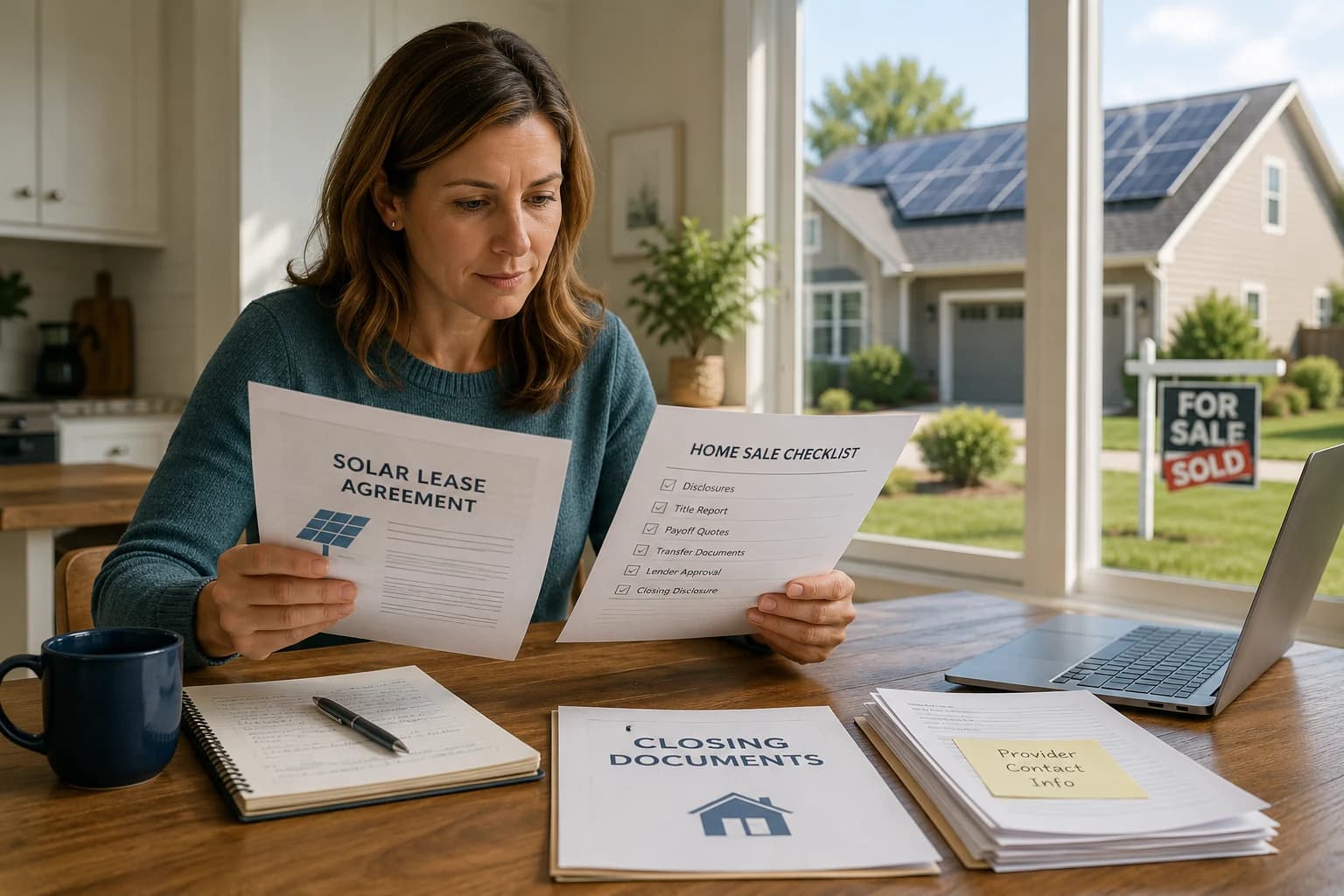
Selling a house with a solar lease is possible, but it is not the same as selling a house with solar panels you own outright. The panels may stay on the roof, but the lease agreement, transfer approval, buyer obligations, title records, and closing paperwork still need to be handled correctly.
The most important point is simple: do not assume the buyer automatically takes over the lease. Some solar leases can be transferred. Some agreements may allow prepayment, buyout, assignment, or another sale-specific option. Some buyers may need to review the agreement, sign transfer documents, or qualify under the provider's process. The details depend on the specific lease and current provider instructions.
This guide explains the practical home-sale workflow for sellers with leased solar panels. It is written for homeowners first, but it also gives buyers, Realtors, title professionals, and attorneys a checklist for spotting lease-transfer issues before they become closing problems.
Quick Answer
Yes, you can usually sell a house with a solar lease. The sale generally requires one of three paths: the buyer accepts and completes the provider's lease-transfer process, the seller prepays or buys out the lease if the agreement allows it, or the parties negotiate another permitted solution before closing.
The seller should start by finding the solar lease agreement, transfer section, current provider instructions, monthly payment details, remaining term, UCC or title documents, and any available buyout or prepayment terms. Then the seller should notify the Realtor, buyer, title company, closing attorney, and mortgage lender that the home has a third-party-owned solar system.
A solar lease does not automatically prevent a sale. But it can affect buyer negotiations, buyer mortgage review, title requirements, and closing timing if the documents are incomplete or the transfer process starts too late.
If you need the broader seller framework for owned systems, loans, leases, PPAs, and UCC filings, start with Oversiq's guide to selling a house with solar panels. This article focuses specifically on leased solar systems.
Key Takeaways
- A solar lease usually means a third-party owner owns the solar equipment, while the homeowner pays for use of the system or related service.
- Selling a house with a solar lease often requires provider approval, transfer documents, buyer review, and closing coordination.
- Buyer approval requirements vary by provider and agreement. Do not assume every buyer faces the same credit review.
- A buyout or prepayment option may exist, but not every lease offers one, and prepayment does not always mean the buyer owns the system.
- UCC filings, title notices, or recorded solar documents may need review even when they relate only to solar equipment.
- Sellers should gather solar lease documents before listing, not after the buyer's lender or title company asks for them.
- Realtors, title companies, lenders, and attorneys should treat the solar lease as a transaction document, not just a utility feature.
What a Solar Lease Means During a Home Sale
A solar lease is different from owning the panels. With owned solar, the seller may be transferring an asset that belongs to the homeowner. With a lease, the seller is usually dealing with a long-term contract connected to equipment owned by someone else.
The Federal Trade Commission's solar guidance explains that with a solar lease or power purchase agreement, the homeowner typically does not own the system. The FTC also warns consumers to review long-term costs, payment increases, maintenance terms, early termination costs, sale-notice obligations, and end-of-term options before signing a solar agreement.
For a seller, those same terms matter again when the home is sold. The buyer may like the idea of solar, but the buyer still needs to understand what they are being asked to accept.
A Lease Is Not Just a Panel Feature
A listing may say "home has solar," but a leased system is not only a physical improvement. It may include:
- a monthly lease payment;
- a remaining contract term;
- payment escalators;
- maintenance and repair obligations;
- production guarantees or service obligations;
- buyer transfer requirements;
- default provisions;
- UCC filings or title notices;
- end-of-term renewal, removal, buyout, or purchase options.
Those details can affect negotiations. A buyer may ask whether the monthly lease payment is offset by electricity savings, whether the payment increases, who repairs the system, what happens if the roof needs work, and whether the lease affects financing.
Solar Lease vs. Solar Loan vs. PPA
Before you plan the sale, make sure you actually have a lease. Sellers often use "solar lease" as a shorthand for any monthly solar payment, but the document may be a lease, a solar loan, a power purchase agreement, or another service contract.
The difference matters:
| Agreement type | Seller issue during a home sale |
|---|---|
| Solar lease | Usually involves third-party ownership and may require transfer approval or buyer acceptance. |
| Solar loan | Usually involves seller-owned equipment with a loan that may need payoff or approved assumption. |
| PPA | Usually involves third-party ownership and payment for generated electricity, often with assignment or transfer rules. |
| Owned outright | Usually simpler, but warranty, monitoring, utility, and proof-of-ownership documents still matter. |
For a deeper comparison, use Oversiq's guide to solar loan vs. lease vs. PPA home-sale issues. This article stays focused on what to do when the agreement is a lease.
Step 1: Confirm the Solar Agreement Type
Start with the documents, not memory. The agreement title, payment terms, company name, and transfer section are more reliable than the way the system was described during installation.
Look for words such as:
- solar lease;
- equipment lease;
- service agreement;
- power purchase agreement;
- PPA;
- loan agreement;
- retail installment contract;
- financing agreement;
- system purchase agreement.
Also identify every company in the paperwork. The installer, solar provider, system owner, servicer, monitoring provider, warranty provider, and payment processor may not be the same company. A seller may have signed with one brand but now receive bills, transfer instructions, or support from another entity.
Tip: > If the agreement says you lease the system, rent the equipment, make lease payments, or pay for use of the equipment, treat the transaction as a leased-solar sale until the provider confirms otherwise in writing.
Step 2: Find the Lease Transfer Language
Once you confirm the agreement is a lease, look for the section that explains sale, transfer, assignment, assumption, relocation, default, early termination, prepayment, or purchase options.
The section may not use the exact phrase "home sale." Search the agreement for terms such as:
- transfer;
- assignment;
- assumption;
- sale of property;
- conveyance;
- buyer;
- new homeowner;
- early termination;
- prepayment;
- purchase option;
- fair market value;
- UCC;
- title;
- escrow.
The goal is to answer five questions:
- Can the lease be transferred to a buyer?
- Does the provider need to approve the buyer?
- What documents must the seller, buyer, escrow, or title company provide?
- Is prepayment or buyout available if the buyer does not accept the lease?
- What written confirmation proves the seller's obligation is resolved after closing?
Do not rely on a verbal answer alone. Ask the provider for current written transfer instructions and keep copies of all transfer-related messages.
Step 3: Start the Solar Lease Transfer Early
Solar lease transfer delays usually happen because the process starts too late. The seller accepts an offer, the buyer's lender asks about the monthly solar payment, the title company finds a recorded filing, and only then does someone call the solar provider.
That is avoidable.
A practical transfer sequence looks like this:
- Seller gathers the lease, amendments, bills, and provider contact information.
- Seller or Realtor asks the provider for current home-sale transfer instructions.
- Seller confirms whether buyer approval or credit review is required.
- Buyer receives the lease, payment schedule, remaining term, and transfer documents.
- Buyer completes any provider-required review or application.
- Provider issues transfer documents for signature.
- Title, escrow, lender, or closing attorney handles any required title/UCC documents.
- Seller confirms closing with the provider.
- Provider updates the account after closing.
- Seller keeps written confirmation showing transfer, prepayment, buyout, or other resolution.
The exact process can vary by company and contract. The structure above is a workflow checklist, not a universal legal rule.
Step 4: Understand Buyer Approval and Credit Requirements
Some solar lease transfers require buyer review or buyer qualification. That does not mean every lease uses the same credit process, and it does not mean every buyer will be rejected if they do not meet one provider's standard.
Provider examples show why the agreement matters. Sunrun, Sunnova, and Tesla each publish home-sale or transfer materials, but their processes are not identical. Depending on the provider and agreement, a transfer may involve buyer information, escrow or title contacts, signatures, credit review, deposit alternatives, title documents, or agreement-type-specific steps.
Those examples are useful, but they are not universal rules. A seller should verify:
- whether the buyer must apply;
- whether the review is a credit check, deposit requirement, document review, or agreement signature;
- whether a spouse, co-buyer, trust, LLC, or estate needs separate review;
- how long the provider expects the process to take;
- what happens if the buyer does not qualify;
- whether closing can proceed before final provider confirmation.
The buyer should also review the economics of the lease. A low monthly payment with a long remaining term may feel different from a higher payment with annual escalators, limited buyout rights, or roof-work obligations.
Step 5: Compare Transfer, Buyout, and Prepayment
When selling a house with a solar lease, sellers often ask whether they should transfer the lease or buy it out. The correct answer depends on the agreement, buyer preference, sale price, closing timeline, and provider terms.
Do not assume that every lease gives the seller every option.
Option 1: Transfer the Lease to the Buyer
Transfer may be the simplest path when the buyer understands the lease and the provider approves the transfer. The buyer may take over the remaining payment obligation, service relationship, and agreement terms after closing.
Before relying on transfer, confirm:
- the remaining lease term;
- current monthly payment;
- annual escalator, if any;
- transfer fee, if any;
- buyer approval requirements;
- required transfer documents;
- timing of account update after closing;
- whether the seller receives written release or confirmation.
Transfer works best when the buyer receives the lease documents early, not after the inspection period or loan underwriting deadline.
Option 2: Prepay Remaining Lease Payments
Some agreements may allow the seller to prepay remaining lease payments or make another sale-related payment. Prepayment can sometimes make the transaction easier because the buyer is not taking over the same monthly payment obligation.
But prepayment is not the same as ownership unless the agreement says so. A prepaid lease may still leave the third-party owner in place, and the buyer may still need to accept service, access, maintenance, roof, or end-of-term provisions.
Ask the provider:
- What amount must be paid?
- Does payment satisfy only future payments or also transfer ownership?
- Does the buyer still need to sign anything?
- Does the provider remove or update any UCC or title notice?
- What written document confirms the result?
Option 3: Buy Out the System
A buyout may allow the seller or buyer to purchase the solar system under the agreement's terms. Some agreements may allow buyout only after a certain period, at fair market value, or under a pricing formula.
Tesla's leasing materials, for example, describe lease transfer and early payoff options, and state that a buyout is available after year five with a price outlined in the contract for Tesla leases covered by that guidance. That is a Tesla-specific example. It should not be treated as a rule for all leases.
Before treating buyout as the solution, confirm:
- whether buyout is allowed now;
- who can buy the system;
- whether the price is fixed, estimated, or fair-market-value based;
- whether tax, transfer, removal, or administrative fees apply;
- whether warranties and maintenance obligations change after buyout;
- whether UCC or title documents must be updated.
Option 4: Negotiate Another Contract-Permitted Solution
Some transactions require a custom solution. The buyer may want a price credit. The seller may offer to prepay a portion of payments. The parties may extend closing while the provider processes transfer documents. The provider may require a particular transfer form, title document, deposit, or release.
These are transaction decisions. Oversiq can help identify document issues, but the parties should use their Realtor, attorney, title company, lender, tax advisor, and financial professionals before making legal, financial, or closing commitments.
Step 6: What If the Buyer Refuses or Cannot Qualify?
A buyer may refuse a solar lease for several reasons. The buyer may dislike the payment, worry about the remaining term, misunderstand the savings, fail the provider's approval process, or have a lender that wants more documentation.
If that happens, the seller should not panic, but should move quickly.
Possible next steps include:
- ask the provider whether another transfer path exists;
- request prepayment or buyout terms;
- ask whether a deposit alternative exists;
- clarify whether the buyer objected to the economics, paperwork, title issue, or approval process;
- provide more complete documents to the buyer and lender;
- discuss price, credit, or closing timing with the Realtor and attorney;
- confirm whether the purchase contract creates any deadlines or rights.
Do not assume a buyer's refusal automatically kills the deal. Also do not assume the seller can force the buyer to accept the lease. The purchase contract, solar lease, local law, lender requirements, and negotiation posture all matter.
For buyer-side review steps, see Oversiq's guide to buying a house with solar panels.
Warning: > A buyer's verbal willingness to "take over the solar" is not enough. The seller should look for written provider approval, signed transfer documents, and closing confirmation.
Step 7: Gather Documents Before Listing
The best time to gather solar lease documents is before the property is listed. A complete file helps the Realtor market the property accurately, helps the buyer review the obligation, and helps the closing team identify title or lender issues early.
Use this seller document checklist:
- original solar lease agreement;
- all amendments, addenda, and transfer forms;
- current billing statement;
- payment schedule and escalator terms;
- remaining lease term;
- provider transfer instructions;
- buyer approval or credit-review requirements;
- prepayment or buyout quote, if requested;
- system owner and servicer contact information;
- maintenance and warranty documents;
- production guarantee, if any;
- monitoring or app-transfer instructions;
- roof access, repair, or removal provisions;
- UCC, title, fixture filing, or notice documents;
- emails or letters from the solar provider about the sale;
- closing confirmation requirements.
If the original installer is no longer the right contact, use the most recent bill, customer portal, assignment notice, servicing letter, or provider status page to identify who currently handles the account.
Step 8: UCC and Title Issues in a Leased-Solar Transaction
Some solar lease and PPA providers record a UCC financing statement, fixture filing, or similar notice to protect or disclose an ownership interest in the solar equipment. That does not automatically mean there is a mortgage-style lien on the home. It also does not mean the issue can be ignored.
The important question is what the buyer's lender and title company need before closing.
Fannie Mae's solar-panel guidance says lenders must obtain and review lease or PPA documents for third-party-owned systems. It also explains that a precautionary UCC filing limited to solar equipment may be acceptable when the documented lease or PPA status takes priority. Freddie Mac's guidance similarly calls for review of solar-panel ownership and any UCC-1 financing statement or lease agreement to determine whether liens relate to the real estate or the solar panels.
Tesla's transfer materials also illustrate the distinction. Tesla states that, for its solar agreements, a UCC-1 financing statement is not a lien against the home and is intended to provide notice of Tesla's ownership interest in the solar system. Tesla also describes temporary release or subordination processes for certain real estate transactions.
The lesson for sellers is practical:
- give the title company the solar lease early;
- ask whether any UCC or title notice appears in the title search;
- ask the provider what release, subordination, update, or explanation letter may be needed;
- do not assume the title company and provider use the same terminology;
- keep written proof of whatever title/UCC step is completed.
For a deeper explanation, read Oversiq's solar UCC filing guide.
Step 9: Mortgage and Lender Considerations
The buyer's mortgage lender may care about a solar lease because the buyer may be taking on a payment obligation or accepting a third-party-owned system attached to the property.
Lender treatment is not always intuitive. Fannie Mae guidance says that for leased solar panels or PPAs, the lender must obtain and review the lease or PPA. It also says the monthly lease payment must be included in the debt-to-income ratio unless the lease is structured in a way that satisfies specific production and fixed-payment conditions. Fannie Mae also states that the value of third-party-owned solar panels cannot be included in the appraised value of the property.
That does not mean every solar lease creates the same underwriting result. It means the buyer's lender may need the document early enough to decide how the payment, ownership, appraisal, title, and insurance requirements apply.
Sellers can reduce friction by giving the buyer:
- the full lease agreement;
- current payment amount;
- remaining term;
- transfer requirements;
- evidence of system ownership;
- UCC/title documentation;
- provider contact information;
- confirmation of buyer approval or transfer status when available.
If the buyer is already under contract and the lender has questions, do not send only a utility bill or solar marketing brochure. Send the actual agreement and provider instructions.
Step 10: Provider Examples Without Treating Them as Universal Rules
Provider examples are useful because they show the types of steps sellers may encounter. They are not substitutes for the specific agreement.
Sunrun
Sunrun's moving guidance describes gathering buyer and escrow contact information, using a transfer portal, signing transfer documents, and completing a soft credit check. If the system is a Sunrun lease, PPA, or service agreement, use the current Sunrun transfer process and your agreement to confirm what applies.
For company-specific context, see Oversiq's Sunrun transfer guide.
Sunnova
Sunnova's seller FAQ says sellers should submit a transfer request as soon as they have a potential buyer, and lists buyer, Realtor, escrow, title, and authorized-contact information as part of the process. It also states that a potential buyer must pass a credit check and sign a transfer agreement, with a deposit alternative described by Sunnova.
For company-specific context, see Oversiq's Sunnova transfer guide.
Tesla
Tesla's materials separate solar transfer steps by agreement type, including lease, PPA, MyPower loan, subscription, cash purchase, Tesla loan, and third-party loan. Tesla's leasing page says a customer selling a home can either transfer the lease to the new homeowner with Tesla's help or pay off the lease early before the sale, subject to the applicable lease terms.
For company-specific context, see Oversiq's Tesla Energy transfer guide.
Common Mistakes That Create Closing Problems
Solar lease problems often come from delay, confusion, or incomplete documents. The mistake is not always that the lease is bad. The mistake is treating it as if it does not need a transaction plan.
Common seller mistakes include:
- listing the property without confirming whether the system is leased, financed, owned, or under a PPA;
- saying the panels are "paid off" when the agreement is actually a lease or prepaid lease;
- assuming buyer approval will be automatic;
- waiting until closing week to ask for transfer documents;
- giving the buyer a bill instead of the full agreement;
- ignoring UCC or title notices until the title company raises them;
- assuming prepayment means ownership transfer;
- failing to ask whether the seller receives written release or transfer confirmation;
- relying on old provider instructions after servicing or company changes;
- using a company-specific rule as if it applies to every solar lease.
Oversiq Insight: > Oversiq Insight: The highest-risk solar lease issue is often not the monthly payment itself. It is the missing document that prevents the buyer, lender, title company, or provider from confirming what must happen before closing.
Solar Lease Seller Closing Checklist
Use this checklist before listing or as soon as a buyer is interested.
- Confirm whether the agreement is a lease, loan, PPA, or owned system.
- Save the complete solar lease agreement and all amendments.
- Identify the current provider, owner, servicer, and payment contact.
- Request current home-sale transfer instructions.
- Ask whether buyer approval, credit review, deposit, or transfer agreement is required.
- Ask whether prepayment, buyout, or purchase options are available.
- Request a written prepayment or buyout quote if relevant.
- Give the solar documents to the Realtor before listing.
- Disclose the monthly payment, remaining term, and transfer process accurately.
- Provide documents to the buyer early in due diligence.
- Send the lease and any UCC/title documents to the title company.
- Ask the buyer's lender whether it needs the lease, payment schedule, or title documentation.
- Track provider signatures and transfer status.
- Confirm whether closing triggers any final notice requirement.
- Keep written confirmation after closing that the account transferred or the obligation was otherwise resolved.
This checklist is not legal advice and does not replace the purchase contract, lease agreement, title review, or attorney guidance. It is a practical way to prevent solar lease issues from being discovered too late.
Realtor, Title, and Attorney Review Notes
Solar lease transactions work better when the professional team treats the lease as part of the transaction file.
For Realtors:
- identify the solar agreement type before writing listing copy;
- avoid saying "owned solar" unless ownership is verified;
- ask for payment, term, transfer, and buyout documents early;
- prepare buyers for the lease review process.
For title professionals:
- check whether any UCC, fixture filing, lease notice, or solar document appears in the title search;
- ask whether the filing relates to solar equipment, the real estate, or both;
- request provider release, subordination, update, or explanation documents when required.
For attorneys:
- review assignment, transfer, default, early termination, buyout, prepayment, removal, roof, and notice provisions;
- confirm whether seller obligations end after closing;
- coordinate solar lease terms with contract deadlines and closing deliverables.
For buyers and lenders:
- review the remaining payment obligation and term;
- ask how the lease affects underwriting, DTI, appraisal, insurance, and title conditions;
- confirm transfer approval before relying on lease assumption or assignment.
FAQ
Can you sell a house with a solar lease?
Yes, you can often sell a house with a solar lease. The lease usually must be transferred, prepaid, bought out, assigned, or otherwise addressed under the specific agreement and provider process.
Does the buyer have to take over the solar lease?
Not automatically. The buyer may agree to take over the lease only if the transaction documents, solar provider, and purchase agreement support that path. The buyer may need to review the lease, sign transfer documents, or qualify under provider rules.
Can a buyer refuse a solar lease?
A buyer can object to the lease as part of the negotiation unless the purchase contract already handles that issue differently. If the buyer refuses, the seller may need to discuss prepayment, buyout, price adjustment, closing timing, or another permitted solution with the transaction team.
Can I buy out my solar lease before selling?
Maybe. Some agreements allow buyout after a certain period or under specific conditions. Others may not. Request written buyout terms from the current provider before promising a buyer that the system can be purchased.
Is prepaying a solar lease the same as buying the system?
Not necessarily. Prepayment may satisfy some future payment obligations without transferring ownership of the system. The agreement and provider confirmation should explain what changes after payment.
Does a solar lease create a lien on the house?
A solar lease may be associated with a UCC filing, fixture filing, or title notice, but that is not automatically the same as a mortgage-style lien on the home. The filing language, collateral description, lease agreement, title company review, and lender requirements matter.
Does a UCC filing stop a home sale?
Not automatically. A UCC filing may be acceptable, may require release or subordination, or may need explanation depending on what it covers and what the buyer's lender or title company requires. Read Oversiq's solar UCC filing explainer for the deeper framework.
Does the buyer need a credit check to transfer a solar lease?
Some providers require buyer credit review or another approval step. Sunrun and Sunnova materials, for example, describe credit-review steps in their transfer processes. Other agreements may use different requirements, so sellers should verify the specific provider process.
How long does a solar lease transfer take?
Timing depends on the provider, buyer responsiveness, title requirements, signatures, closing date, and whether any UCC or payment issue must be resolved. Sellers should start as early as possible rather than waiting for closing week.
What documents should I give the buyer?
Provide the full lease agreement, amendments, current bill, payment schedule, remaining term, transfer instructions, buyout or prepayment quote if available, warranty and maintenance terms, provider contact information, and any UCC or title documents.
Should I transfer the lease or buy it out?
That depends on the lease terms, buyout price, buyer preference, sale price, lender requirements, and closing timeline. Compare the written transfer process with the written buyout or prepayment quote before deciding.
Is a solar lease different from a solar loan when selling?
Yes. With a solar lease, the homeowner usually does not own the system. With a solar loan, the homeowner usually owns the system but still owes money. Loan assumption and lease transfer are different processes. For the loan-specific issue, read Can a Buyer Assume a Solar Loan?.
Review Your Solar Lease Before Closing
A solar lease should be reviewed before the buyer, lender, title company, or closing attorney is under deadline pressure. The right question is not just "Does the home have solar?" It is "What does the lease require before this sale can close cleanly?"
Oversiq helps homeowners and real estate professionals analyze uploaded solar documents for transfer, buyout, prepayment, UCC/title, servicing, and closing issues. You can view a sample report, see pricing, or start by uploading your solar agreement for document-specific review.
Oversiq provides informational document analysis only. It is not a law firm, title company, lender, tax advisor, or financial advisor. Sellers, buyers, Realtors, title companies, lenders, and attorneys should verify the transaction requirements before acting.
About the author
Oversiq Editorial Team creates educational resources about residential solar documents, financing terms, company risk, and real estate transaction issues for Oversiq readers.