Solar UCC Filing Explained: What Homeowners Need to Know Before Selling a House
A plain-English guide to solar UCC filings, title searches, payoff, releases, refinancing, and what homeowners should verify before selling a house.
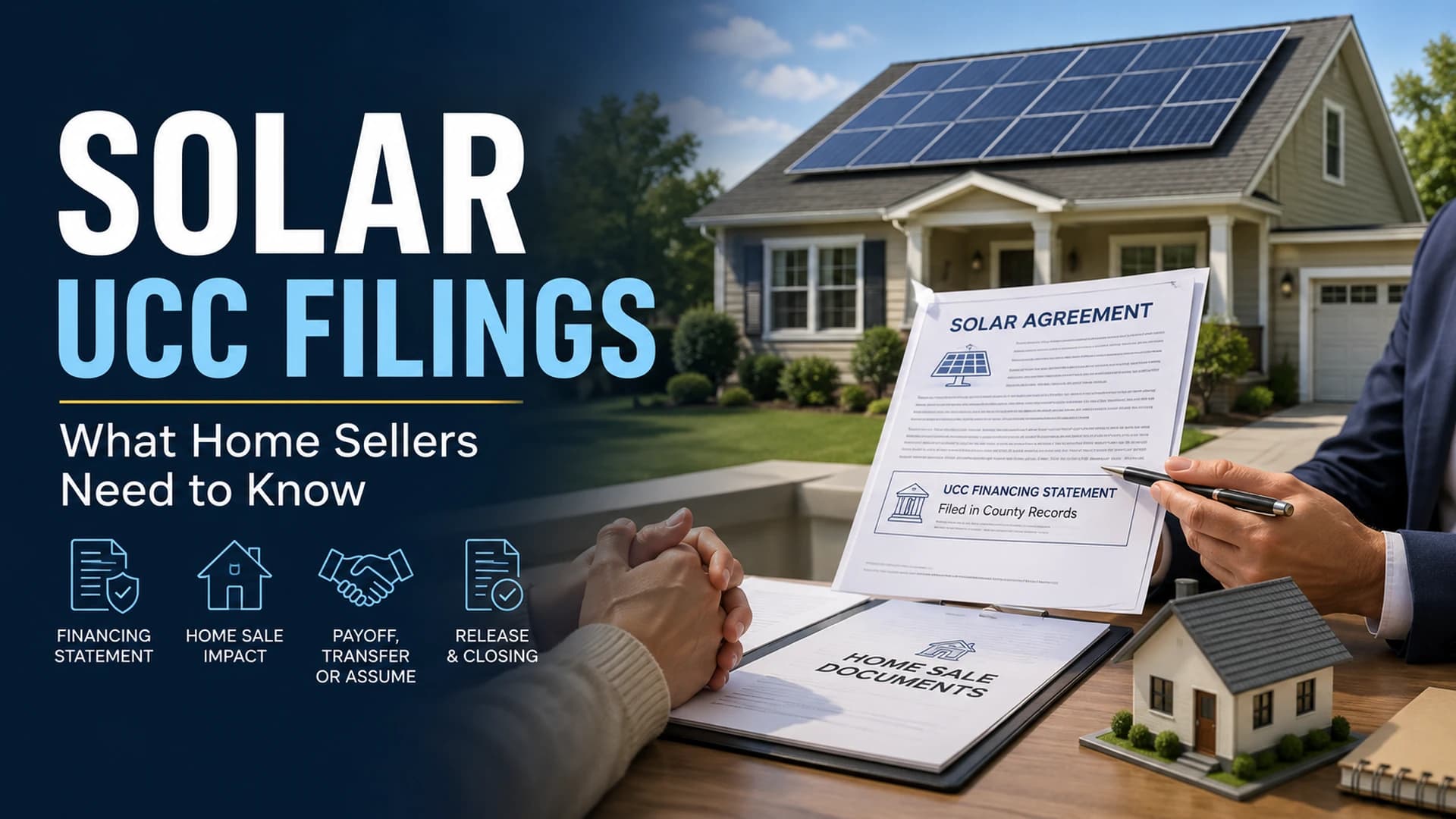
A homeowner is preparing to sell a house with solar panels. During title work, payoff preparation, refinancing review, or document review, someone notices a UCC filing connected to the solar system.
The first question is usually simple:
"Does this mean there is a lien on my house?"
A solar UCC filing should not automatically be treated as a mortgage-style lien against the home. It also should not be ignored just because a provider describes it as related to solar equipment. The practical question is what must happen before the property can close cleanly.
This guide explains solar UCC filings from a transaction perspective. It is written for homeowners first, but it also gives buyers, Realtors, attorneys, and title professionals a shared framework for asking better questions before closing pressure builds.
For the broader selling process, see Oversiq's guide to Selling a House With Solar Panels.
Quick Answer: What Does a Solar UCC Filing Mean?
A solar UCC filing is generally a public financing statement connected to a claimed security interest in solar equipment, related collateral, or a solar agreement. It is not automatically the same as a mortgage-style lien on your house. But title companies and mortgage lenders may still require review, documentation, payoff instructions, release language, subordination, transfer approval, or UCC-3 termination before a sale or refinance can close cleanly.
The safest next step is to gather the solar agreement, financing documents, title report, UCC filing, current statement, payoff or transfer instructions, and current lender or servicer contact information. Then ask the title company, lender, attorney, and solar provider or servicer what the transaction requires.
Do not treat "not a mortgage lien" as the same thing as "no closing issue."
Key Takeaways
- A solar UCC filing does not automatically mean there is a mortgage-style lien on the house.
- The filing may relate to solar equipment, a solar agreement, or another claimed collateral interest.
- Title companies and mortgage lenders may still require documents before closing or refinancing.
- Paying off a solar obligation and terminating or releasing a UCC filing are related but separate concepts.
- A UCC-1 financing statement and a fixture filing are not identical, and filing treatment can depend on state law and the transaction facts.
- Sellers, Realtors, and closing teams should start payoff, transfer, title, and UCC review early.
What Is a Solar UCC Filing?
The Uniform Commercial Code is a body of commercial law adopted by states. Article 9 deals with secured transactions. In plain English, a secured transaction is a situation where one party has an interest in certain property as collateral for payment or performance.
A solar UCC filing is a UCC financing statement connected to a solar transaction. It may identify a homeowner or borrower as debtor, a lender or other party as secured party, and solar panels, inverters, batteries, related equipment, or agreement rights as collateral. State filing offices describe UCC filings as a way to record or give public notice of the debtor, secured party, and collateral relationship. For example, New Jersey's Division of Revenue and Enterprise Services explains that UCC financing statements record and protect a secured party's interest in collateral and give public notice of the debtor-secured party relationship. Texas Secretary of State guidance describes a security interest as an interest in personal property or fixtures that secures payment or performance of an obligation.
For a homeowner, the important point is this:
The UCC filing is a public notice record. The underlying solar agreement, loan, lease, PPA, or security agreement explains the actual obligation.
The common terms are:
| Term | Plain-English meaning | Why it matters |
|---|---|---|
| Debtor | The person or entity whose property is listed as collateral | Often the homeowner or borrower |
| Secured party | The party claiming an interest in collateral | May be lender, creditor, provider, assignee, or other party |
| Collateral | The property tied to the security interest | In solar, this may include panels or related equipment |
| Security interest | An interest that secures payment or performance | Different from saying there is automatically a mortgage lien |
| UCC-1 | The initial financing statement form | Often the first public filing people find |
| UCC-3 | Amendment form often used for continuation, assignment, amendment, or termination | May be relevant for release or termination questions |
| Fixture filing | A UCC filing connected to goods that are or may become fixtures | May appear in real-property records depending on the facts |
For official forms, the International Association of Commercial Administrators lists current UCC1 and UCC3 forms. State filing offices administer their own filing systems and rules.
Why Would a Solar Company or Lender File a UCC?
Residential solar can involve more than panels on a roof. It can involve a loan, lease, power purchase agreement, service agreement, ownership notice, security agreement, or equipment financing structure.
A solar company, lender, creditor, or financing party may use a UCC filing to give public notice of an interest in the solar equipment or related agreement. The Consumer Financial Protection Bureau describes solar-specific loans as private installment loans often offered through point-of-sale relationships among installers, salespeople, and lenders. Some solar loans may involve collateral interests or UCC/title issues.
The filing may be connected to:
- a solar loan used to finance equipment
- a lease or PPA where another company owns the system
- a secured party's interest in solar panels or related equipment
- a fixture filing connected to equipment attached to real property
- a release, subordination, assignment, continuation, or termination history
The company name can be confusing. The installer, solar provider, lender, creditor, loan owner, secured party, assignee, and servicer may not be the same company. A homeowner may recognize one brand from the sales process, but the UCC filing may name a different secured party or a servicer may now handle an account that another company originated.
That is why the Solar Glossary can be useful when a transaction team needs to use the same language for lender, servicer, payoff, assignment, UCC filing, lease, PPA, and security interest.
Is a Solar UCC Filing a Lien on Your House?
This is the question that creates the most confusion.
Many people call a solar UCC filing a "solar lien." That phrase may be common in conversation, search results, title discussions, or closing emails. But it can be imprecise.
A UCC financing statement may give public notice of a security interest in solar equipment. That is not automatically the same as a mortgage-style lien against the land and house. Several official provider sources make that distinction. GoodLeap says its UCC-1 and county fixture filings are intended to protect its security interest in the solar system and are not a lien against the home. Tesla similarly describes UCC-1 filing or title release issues in connection with solar financing and real estate transactions, while distinguishing them from the home itself in certain contexts. Solar Servicing, which services Mosaic loans, describes its UCC-1 state and county liens as documenting a secured interest in personal property, the solar equipment, not real property.
But the opposite mistake is also common. Some people hear "not a lien on the home" and assume the filing cannot matter. That is not safe either.
Fannie Mae and Freddie Mac mortgage guidance shows why solar ownership, lease, PPA, financing, UCC, title, security agreement, release, and subordination questions can matter in mortgage underwriting and property eligibility review. A filing may not be a mortgage lien in the ordinary sense and still create title, lender, payoff, or closing questions.
Oversiq Insight: > Why this distinction matters at closing: a filing can be tied to solar equipment instead of the house itself and still require title, lender, payoff, release, subordination, transfer, or attorney review before a transaction team is comfortable closing.
Warning: > Do not rely only on the label "lien" or "not a lien." Review the actual filing, collateral description, solar agreement, title report, and lender or title requirements.
Better questions include what property the filing describes, whether it is tied to equipment or fixtures, who the secured party is, whether payoff or release is needed, and what the buyer's lender or title company requires.
UCC-1 vs. Fixture Filing: Why the Difference Matters
A fixture filing is a specific UCC concept. UCC Article 9 definitions describe fixtures as goods that have become so related to particular real property that an interest in them arises under real property law. A fixture filing is a financing statement that covers goods that are or are to become fixtures and satisfies additional real-property-related requirements.
That matters for solar because solar equipment is physically attached to a home. Panels, racking, inverters, batteries, and related equipment may raise questions about personal property, fixtures, collateral, ownership, and title.
A UCC-1 and a fixture filing are not automatically the same thing. A UCC-1 is the financing statement form. A fixture filing is a type of filing connected to goods that are or may become fixtures and may be filed in a real property recording office depending on state law and the nature of the filing. UCC 9-502 describes additional requirements for a financing statement filed as a fixture filing.
Fannie Mae describes a UCC fixture filing as a UCC-1 financing statement covering property affixed or to be affixed to real property and filed in the office where mortgages are recorded under the law of the state where the real property is located.
Do not assume every solar filing is a fixture filing. Do not assume every fixture filing has the same effect in every state. Fixture and real-property recording questions can depend on state law, the filing office, the solar documents, the collateral description, and the title or lender review. This article uses New Jersey, California, and Texas filing-office materials as examples, not as a 50-state filing procedure.
| Topic | UCC-1 financing statement | Fixture filing |
|---|---|---|
| Purpose | Gives public notice of a claimed security interest | Gives public notice involving goods that are or may become fixtures |
| Typical solar collateral | Solar panels, inverters, batteries, related equipment, or agreement rights | Solar equipment connected to real property |
| Possible filing location | Often a state UCC filing office, depending on state law and collateral | May involve real-property records, depending on state law and filing type |
| Connection to real property | Not automatically a mortgage lien on the home | More directly connected to real-property records and title review |
| Why title may see it | It may appear in UCC, title, or closing-document review | It may appear in county or land-record review |
| What homeowner should verify | Secured party, collateral, status, payoff or release requirements | Filing office, collateral description, title requirement, release or subordination process |
The practical takeaway is not that one label is always safe and the other is always a problem. The practical takeaway is that the filing location, collateral description, agreement type, state law, and title requirements all matter.
Why Title Companies and Mortgage Lenders Care About Solar UCC Filings
A solar UCC filing may appear during title search, county records review, UCC search, refinancing, buyer-lender review, payoff preparation, solar transfer, attorney review, or closing preparation. It may be labeled as a UCC-1, fixture filing, financing statement, solar lien, title exception, recorded notice, or secured-party reference. The wording varies by state, title company, filing office, and provider.
For title companies and mortgage lenders, the concern is usually not academic. They need to know whether the filing affects the transaction, priority, payoff, release, subordination, or closing documents. A buyer's lender may ask for clarification because the lender needs to understand ownership, debt, collateral, title exceptions, and any required release or subordination before funding.
A filing discovered early can usually be investigated with less pressure. A filing discovered near closing can create urgent questions about payoff, buyer assumption, release, subordination, termination, lender documentation, current servicer identity, and fixture-filing treatment.
Oversiq's title company solar resources cover this kind of closing coordination.
Can You Sell a House With a Solar UCC Filing?
Often, yes. A solar UCC filing does not automatically prevent a home sale.
But "can sell" is not the same as "nothing needs to be done." The transaction team still has to determine what the filing means and whether any action is required before or after closing.
Use this practical workflow:
- Identify the solar agreement type: cash-owned system, solar loan, lease, PPA, service agreement, subscription agreement, or PACE if applicable.
- Identify the current lender, servicer, provider, secured party, assignee, or creditor.
- Gather the agreement, current account statement, title report, UCC filing, and any payoff or transfer documents.
- Determine whether the transaction requires payoff, buyer assumption, transfer approval, release, subordination, UCC-3 termination, or written explanation.
- Ask the title company, buyer's lender, attorney, and solar provider or servicer what documentation they require.
- Confirm and retain payoff confirmation, transfer approval, release, subordination, UCC-3, or other closing proof.
Possible transaction outcomes include:
| Situation | Possible transaction response |
|---|---|
| Filing is tied to an active solar loan | Request payoff, assumption, release, or title instructions |
| Filing is tied to a lease or PPA | Confirm assignment or service transfer requirements |
| Buyer lender needs priority protection | Request subordination or explanation if available and required |
| Filing is old or unclear | Identify current secured party, servicer, assignee, or successor |
| Filing remains after payoff | Ask title/attorney/provider what release or termination documentation is needed |
The specific solar agreement matters. A loan, lease, PPA, service agreement, prepaid contract, and owned system can each raise different questions. Oversiq's guide to solar loan vs. lease vs. PPA home-sale outcomes explains how those agreement types change payoff, transfer, buyer approval, and title review. For the broader home-sale process, see Oversiq's solar home sale guide.
Why Your Solar Agreement Type Matters
A solar UCC filing cannot be understood in isolation from the solar agreement. The same words may appear in a title search, but the closing response can differ depending on whether the homeowner owns the system, financed it, leased it, or signed a PPA.
| Solar arrangement | Why it matters for UCC/title review |
|---|---|
| Cash-owned system | There may be no active financing obligation, but old filings, releases, warranties, and ownership records should still be checked. |
| Solar loan | The borrower may own the system while a lender or secured party claims an interest in solar equipment or related collateral. |
| Solar lease | A third-party owner may retain system ownership, and transfer or assignment approval may be required. |
| Power purchase agreement | The homeowner may be buying solar power under a long-term agreement rather than owning the equipment. |
| PACE or tax-assessment financing | This can raise separate property-tax or assessment issues and should not be treated as an ordinary solar UCC question. |
This section is only the transaction-specific overview. For a deeper comparison, read Solar Loan vs. Lease vs. PPA: What Happens When You Sell Your Home?.
Paying Off Solar Is Not Always the Same as Terminating the UCC Filing
Payoff and public-record cleanup are related, but they are not the same thing.
Payoff addresses the financial obligation. It answers a money question: what amount is required to satisfy the loan or other balance as of a certain date? A UCC release, subordination, amendment, or termination addresses a public-record or title-document question: what needs to happen to the filing that appears in UCC, title, or real-property records?
Not every solar loan must be paid off during a sale. Some lenders may allow buyer assumption if the buyer qualifies and the lender approves. Other loans may need payoff. Provider examples from GoodLeap, Dividend Finance, and Solar Servicing show why the answer depends on the agreement, lender, servicer, and current instructions. For the deeper buyer-assumption question, read Can a Buyer Assume a Solar Loan?.
Oversiq Insight: > Payoff does not always mean the public filing disappears automatically. The closing team should confirm whether a UCC-3 termination, release, subordination, written explanation, or other record update is required.
In some situations, payoff may trigger a release or termination process. In others, a provider may temporarily release or subordinate a filing for refinancing and later refile or reinstate its position. Some public filing systems may continue showing historical information even after a termination or amendment is filed.
For that reason, sellers should keep payoff quotes, proof of payment, release or termination instructions, UCC-3 or filing-office confirmations, title-company or attorney confirmations, and provider or servicer correspondence.
How Is a Solar UCC Filing Removed or Terminated?
A solar UCC filing may be addressed through payoff, release, subordination, assignment, amendment, continuation, temporary release, or termination depending on the facts.
The most common search phrase is "remove solar UCC filing," but the precise process depends on who has authority and what the transaction requires.
UCC-3 is the amendment form commonly used for continuation, assignment, amendment, or termination. UCC Article 9 includes the concept of a termination statement. State filing offices also describe UCC-3 forms as tools for amendment, assignment, continuation, termination, or partial release.
But a homeowner should not assume they can simply file something and resolve the issue. The secured party or authorized party may need to provide the termination, release, subordination, or other document. The title company or attorney may need to determine which document is required. The solar provider or servicer may have its own process.
The key distinction:
Addressing the public filing and satisfying the underlying solar obligation are related, but they are not automatically the same event.
For example, paying off a loan may trigger a release or termination process. But the closing team still needs to confirm timing, documentation, recording, and public-record status. A temporary release for refinance may later be refiled. A subordination may allow another lender to take priority without eliminating the solar obligation.
What Is a UCC-3 Termination?
A UCC-3 is a financing statement amendment form. It can be used for amendment, continuation, assignment, partial release, and termination. In a solar home-sale context, homeowners usually hear about UCC-3 because a title company, lender, provider, or attorney is asking whether a filing has been terminated or released.
A termination generally indicates that the financing statement is no longer effective, but the correct process depends on the filing, secured party, state filing rules, agreement terms, and transaction facts. A homeowner should not assume that downloading a form or submitting a casual request will clear the issue.
The practical questions are who controls the filing, whether the underlying obligation has been paid or transferred, what document title requires, which filing office is involved, and what confirmation the seller should keep.
How to Check for a Solar UCC Filing
There is no single universal search path for every solar UCC filing. Depending on the state, collateral, agreement, and filing type, relevant records may appear in more than one place.
Possible sources include the state UCC filing office or Secretary of State database, county land or property records, title report, UCC search request, solar financing documents, and payoff, release, subordination, or transfer packet.
One database search may not tell the whole story. A state-level search may not capture every county real-property record. A county search may not show every state UCC filing. A title report may identify a recorded issue without explaining the current payoff, transfer, or servicer process.
Oversiq can help homeowners organize solar and transaction documents and identify UCC-related language in those documents. It is not an official UCC search service and does not replace title, lender, or attorney review.
What About Refinancing?
Refinancing can raise different questions from selling.
Some providers describe temporary UCC release or subordination processes for refinance. GoodLeap says a refinance can often proceed because its UCC is not a lien against the home, but it may agree to lift the county UCC-1 filing for a limited period and refile after closing. Tesla describes UCC-1 release or subordination requests for refinancing and other real estate transactions, and notes that a Tesla loan UCC release may be temporary if the loan is not paid in full.
Mortgage lender guidance also matters. Fannie Mae and Freddie Mac both address solar ownership, financing, leases, PPAs, UCC records, title review, and lien priority in solar-panel property guidance.
The homeowner questions are practical: does the lender require release, subordination, payoff, explanation, or temporary filing action, and will anything be refiled after refinance?
Do not assume a solar UCC filing blocks refinancing. Do not assume it is irrelevant either.
Solar UCC and Transfer Practices Can Vary by Company
Solar companies, lenders, and servicers do not all use the same transfer, payoff, UCC release, or refinance process. Homeowners should verify current instructions instead of relying on general assumptions.
| Company or servicer | What it illustrates | What to verify |
|---|---|---|
| GoodLeap | UCC-1 or fixture filing language tied to solar equipment and possible payoff or buyer assumption | Current payoff, assumption, refinance, and filing instructions |
| Tesla | Ownership transfer, payoff, UCC release, and refinance processes can differ | Agreement type, payoff status, title-release steps, and financing transferability |
| Mosaic / Solar Servicing | Servicing can transition after restructuring | Current servicer, payoff process, filing authority, and transfer availability |
| Dividend Finance | Buyer transfer may require credit approval | Buyer-approval process and payoff timing |
| Sunnova | Lease or PPA transfer may require buyer/title/escrow coordination | Transfer packet, agreement requirements, and closing timeline |
| Sunrun | Transfer may involve buyer and escrow information, signatures, credit review, and title notices | Current transfer workflow and title/UCC handling |
The name on the roof, the name on the loan, the name on the UCC filing, and the name collecting payments may not be the same.
What If the Solar Company, Lender, or Servicer Changed?
Company failure can make a UCC issue harder to resolve because the company the homeowner remembers may not be the company with authority today.
The installer, lender, creditor, servicer, secured party, and solar provider may be different companies. If the installer closed, the loan may still exist. If a lender restructured, another servicer may be collecting payments. If a provider sold assets, a successor or assignee may handle some accounts but not every historical obligation.
Bankruptcy does not automatically eliminate the filing or the homeowner's contract obligations. It also does not automatically identify who can release, subordinate, terminate, or explain the UCC filing.
For example, Mosaic loan servicing transitioned to Solar Servicing after Mosaic's court-approved Chapter 11 Plan of Reorganization. Solar Servicing says servicing continues for most customers unless borrowers are told otherwise, but it does not currently offer loan transfers for home sales involving active loans it services.
If a solar company, lender, or servicer appears inactive, start with the name listed on the UCC filing, current account statement, latest payment portal, solar agreement, any assignment or servicing-change notice, and the Solar Company Status Center.
For broader context, see Oversiq's guide to what happens if your solar company goes bankrupt. Mosaic borrowers should also review the Mosaic solar transfer guide.
Common Solar UCC Problems That Can Delay a Closing
A solar UCC filing does not always delay closing. It can create avoidable pressure when payoff is requested too late, the current servicer is unclear, a filing still appears after payoff, title requests additional documentation, a fixture filing appears in real-property records, a buyer transfer is not approved, or lender requirements conflict with the solar arrangement.
The solution is usually process discipline, not panic: collect the documents, identify the current party, ask what the transaction requires, and keep written confirmation.
What Homeowners Should Gather Before Selling
Do not wait until closing week to collect solar documents. A UCC filing is easiest to resolve when the seller, Realtor, title company, attorney, lender, and provider can review the same documents early.
Useful documents to gather:
| Document | Why it matters | Who may request it |
|---|---|---|
| Original solar agreement | Shows whether the arrangement is a loan, lease, PPA, service agreement, or other structure | Seller, buyer, Realtor, attorney |
| Current account statement | Identifies current account status, payment details, and possible servicer | Title, escrow, lender, attorney |
| Payoff quote or payoff demand | Shows the amount and date needed if payoff is required | Closing team, escrow, lender |
| Transfer or assumption packet | Shows whether the buyer can assume or transfer the obligation | Buyer, Realtor, provider, lender |
| UCC-1 or fixture filing | Shows secured party, debtor, collateral, filing date, and filing office | Title, attorney, lender |
| UCC-3, release, or subordination | Shows whether a filing was amended, terminated, released, or subordinated | Title, lender, attorney |
| Title report or title commitment | Shows what title actually found and what exceptions may exist | Seller, buyer, attorney |
| Buyer lender request | Shows underwriting or title conditions tied to solar | Seller, buyer, Realtor |
| Servicing-transfer notice | Helps identify the current servicer if the original company changed | Seller, title, attorney |
| Proof of payoff or transfer | Documents what happened at or before closing | Seller, buyer, closing team |
Not every transaction will require every document. The goal is to avoid discovering the missing document after the buyer's lender or title company has already set a deadline.
If the UCC or title question is tied to leased solar, also review Oversiq's guide to solar lease UCC issues during a home sale.
If you are trying to understand what a solar agreement requires during a home sale, Oversiq can help organize solar agreements, identify UCC-related language, and surface payoff, transfer, and title questions before closing pressure builds.
What Realtors Should Check Early
Realtors do not need to interpret Article 9 or determine lien priority. Their value is early identification and escalation: ask whether the panels are owned, financed, leased, or under a PPA; whether a UCC filing or fixture filing appears; who the current lender or servicer is; and whether payoff, transfer, release, or subordination instructions are available.
A better Realtor message is:
"There may be a solar-related UCC filing or financing record. We should get the solar documents, title report, payoff or transfer instructions, and current servicer information to the title company and attorney early."
For workflow support, see the Realtor Solar Listing Checklist and Oversiq's Realtor resources.
When to Involve the Title Company or Attorney
Different parties answer different questions.
| Party | Questions they may help answer |
|---|---|
| Title company or escrow | What documents are required to clear, insure, disclose, or close the transaction? |
| Solar lender or servicer | What is the payoff, transfer, assumption, release, subordination, or filing process? |
| Buyer's mortgage lender | Does underwriting require solar documents, release, subordination, payoff, or explanation? |
| Real-estate attorney | What do the contract, addendum, title record, filing, and state-specific legal issues require? |
| Oversiq | What solar documents exist, what agreement type appears, and what UCC, payoff, transfer, or closing-related language should be flagged for review? |
Title or legal review becomes especially important when:
- a UCC fixture filing appears in real property records
- a title report lists a solar UCC, solar lien, fixture filing, lease notice, or title exception
- the buyer's lender asks for release, subordination, payoff, UCC-3, or explanation
- the secured party is unclear, bankrupt, merged, inactive, or different from the current servicer
- the seller says the loan was paid off but a filing still appears
- the purchase agreement or solar addendum is unclear about payoff, assumption, or transfer
This article is educational, not legal, title, or financial advice. A title company or attorney can review the actual record, agreement, state filing requirements, and closing obligations.
Common Solar UCC Filing Misconceptions
| Myth | Reality |
|---|---|
| A solar UCC filing means there is definitely a mortgage-style lien on my house. | Not automatically. Many solar filings are connected to an interest in equipment or a solar agreement, but the actual filing, collateral, agreement, state law, and title review matter. |
| If it is not a home lien, it does not matter. | It can still matter in title, lender, refinance, payoff, release, subordination, or closing review. |
| The solar company went bankrupt, so the filing does not matter. | Bankruptcy or closure does not automatically eliminate the obligation or filing. The current creditor, servicer, secured party, assignee, or successor still needs to be identified. |
| The buyer can just take over the solar loan. | Buyer assumption depends on the specific financing arrangement, provider rules, buyer approval, and written documentation. |
| Once the UCC filing is terminated, everything is resolved. | Termination of a public filing and satisfaction or transfer of the underlying obligation are related but not identical. |
| The installer can always remove it. | The installer may not be the secured party, creditor, servicer, or party with authority over the filing. |
| One search proves everything is clear. | State UCC records, county records, title reports, and provider documents may not all show the same information. |
Frequently Asked Questions
What is a UCC filing on solar panels?
A UCC filing on solar panels is usually a public financing statement connected to a claimed interest in solar equipment or a solar agreement. It may identify a debtor, secured party, and collateral.
Is a solar UCC filing a lien on my house?
Not automatically. Some providers describe solar UCC filings as related to solar equipment rather than a mortgage-style lien against the home. But the filing can still matter in title, lender, refinance, payoff, release, or closing review.
Can I sell my house with a solar UCC filing?
Often, yes. The sale may still proceed if the filing and related solar obligation are handled correctly. The transaction team should review the solar agreement, title report, UCC record, payoff or transfer instructions, and provider requirements.
Can a solar UCC filing delay closing?
It can if the issue is discovered late or if documents, payoff instructions, release requirements, servicer information, or title requirements are missing. It does not automatically delay every closing.
Does a solar UCC filing affect refinancing?
It may. Some refinances require a release, temporary release, subordination, payoff, or explanation. Provider and lender requirements vary, so homeowners should confirm the process with the lender, title company, and solar provider or servicer.
Does paying off solar remove the UCC filing?
Not automatically. Payoff may satisfy the financial obligation, but the public filing may still need a release, UCC-3 termination, subordination, or other confirmation.
How do I remove a UCC filing for solar panels?
The process depends on the filing, secured party, agreement, payoff status, and state filing rules. It may involve release, subordination, UCC-3 termination, amendment, or other documentation.
What is a UCC-3 termination?
A UCC-3 is a financing statement amendment form. It can be used for several actions, including termination. A termination statement generally indicates that a financing statement is no longer effective, but the correct process depends on the facts and filing office.
Who removes or releases a solar UCC filing?
Usually the party with authority over the filing, such as the secured party or its authorized representative, must provide the necessary release, termination, subordination, or amendment. The homeowner should not assume the installer controls the process.
Where can I search for a solar UCC filing?
Possible search locations include the state UCC filing office, Secretary of State database, county land or property records, a title report, or a formal UCC search request. The right place depends on the state, collateral, filing type, and transaction facts.
What is the difference between a UCC-1 and a fixture filing?
A UCC-1 is a financing statement form. A fixture filing is a UCC filing connected to goods that are or may become fixtures and may involve real-property records depending on state law and the filing facts. A solar filing should be reviewed in context instead of judged by label alone.
What happens if the solar lender or company went bankrupt?
Bankruptcy or closure can make it harder to identify the right party, but it does not automatically erase the obligation or filing. The transaction team should identify the current servicer, creditor, secured party, assignee, or successor.
The Bottom Line
A solar UCC filing should not be reduced to a simple yes-or-no answer about whether there is a "solar lien" on the house. The better question is what agreement exists, who is responsible for it today, what filing exists, and what has to happen before this property is sold or refinanced.
A filing may be connected to solar equipment rather than a mortgage-style lien on the home and still appear in title or lender review. The safest path is practical: identify the agreement, current creditor or servicer, UCC filing, title requirement, and payoff or transfer instructions before closing pressure builds.
Oversiq can help review solar documents, identify UCC-related language, and organize the questions sellers, buyers, Realtors, attorneys, title teams, lenders, and solar companies need to answer.
About the author
Oversiq Editorial Team creates educational resources about residential solar documents, financing terms, company risk, and real estate transaction issues for Oversiq readers.